

Is Your Product Affected? High-Risk Indian MSME Sectors Under EU CBAM (Annex I Breakdown)

“Do You Need to Care Today?” (The 30-Second Audit)
The Baseline Reality: The Taxing Phase Has Arrived
The grace period for the European Union’s Carbon Border Adjustment Mechanism (CBAM) is officially over. What began as a mandatory reporting exercise—where EU importers merely submitted quarterly spreadsheets detailing embedded emissions—has transitioned into its definitive phase.
EU buyers are now required to surrender financially backed CBAM certificates matched directly to the verified greenhouse gas (GHG) footprint of imported goods. Every tonne of embedded carbon in your product now carries a direct financial cost in Euros based on the EU Emissions Trading System (EU ETS) allowance prices.
If you export to the EU, your buyers are actively assessing their supply chain liabilities. The central question on every European procurement manager’s desk right now is straightforward: Which suppliers can provide verified emissions data to keep compliance costs manageable, and which will trigger penalty-rate default charges?
The Big Misconception: “We’re Too Small for Carbon Taxes”
Ask ten Indian engineering MSME founders about CBAM, and eight will likely give you some variation of the same answer:

“CBAM is a climate tax on heavy polluters. We don’t operate blast furnaces or primary aluminium smelters. We buy commercial steel bars or extrusions, machine them into nuts, bolts, flanges, or tubes, and ship them. Our factory doesn’t emit massive smokestacks of carbon, so CBAM doesn’t apply to us.”
This line of thinking is understandable, logical—and costly.
CBAM was specifically designed to prevent “carbon leakage”—the practice of transferring carbon-intensive production outside the EU. To stop companies from bypassing raw metal tariffs by importing semi-finished or finished metal products instead, European lawmakers deliberately extended CBAM deep into downstream manufacturing.
The Cold Fact: Downstream Products Are Directly Targeted
Under Annex I of Regulation (EU) 2023/956, the scope of CBAM is determined entirely by product classification codes, not by facility size or whether you melt raw ore.
If you manufacture downstream engineering goods—such as fasteners (screws, bolts, nuts under CN Code 7318), welded pipes, steel tubes, structures, or aluminium profiles—your product is explicitly listed in Annex I.
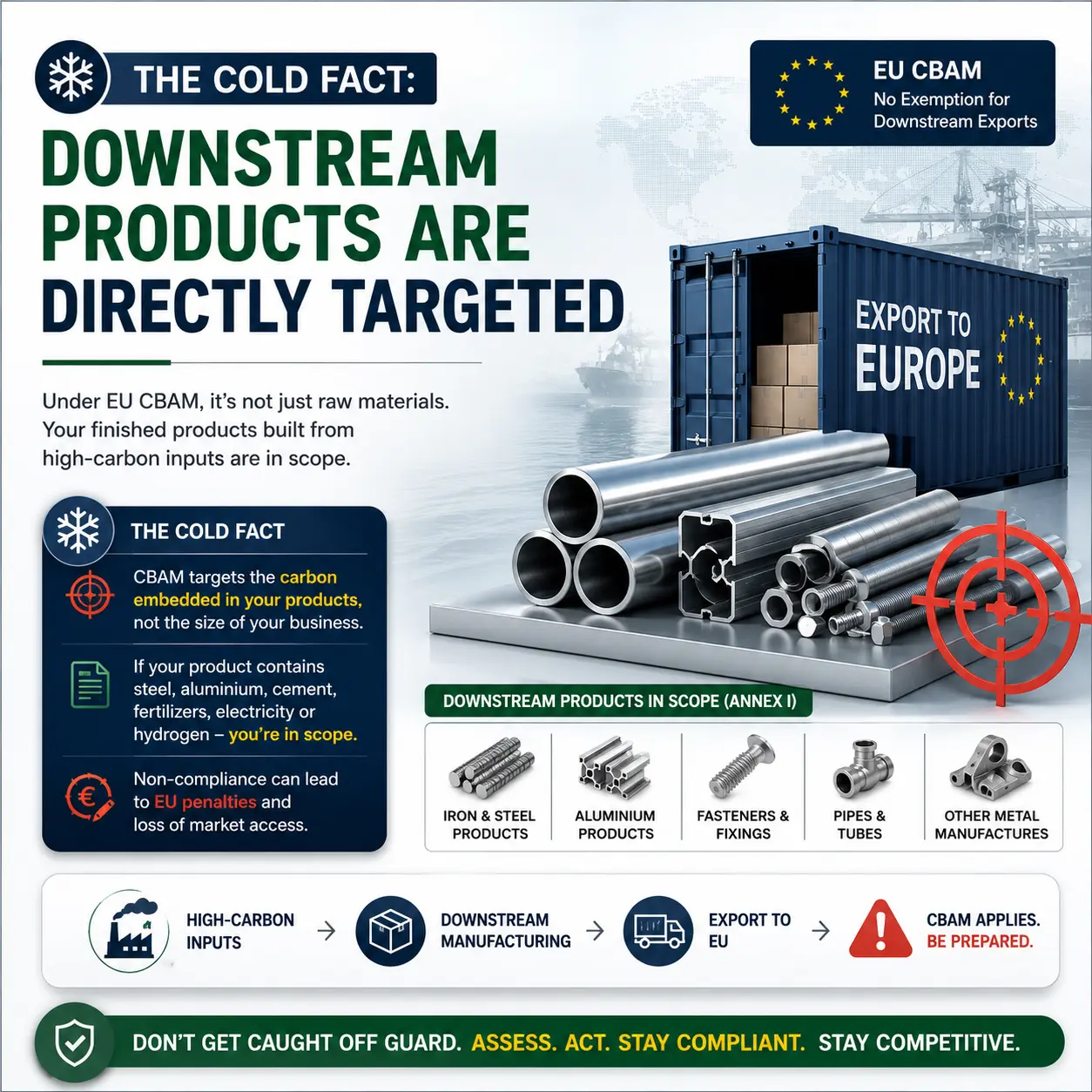
When your EU customer asks for your product’s embedded emissions, they aren’t just measuring the electricity used by your CNC machines. They are legally required to account for the carbon generated when the raw steel or aluminium was originally produced by your primary suppliers.
If you cannot provide primary plant-level data for those raw materials, European customs authorities won’t block your shipment—they will apply high, pre-calculated default values. That penalty surcharge gets added directly to your buyer’s invoice, instantly making your product 10% to 30% more expensive than competitors from compliant supply chains.
In short: If you cannot provide embedded carbon data today, your customer relationship is on borrowed time.
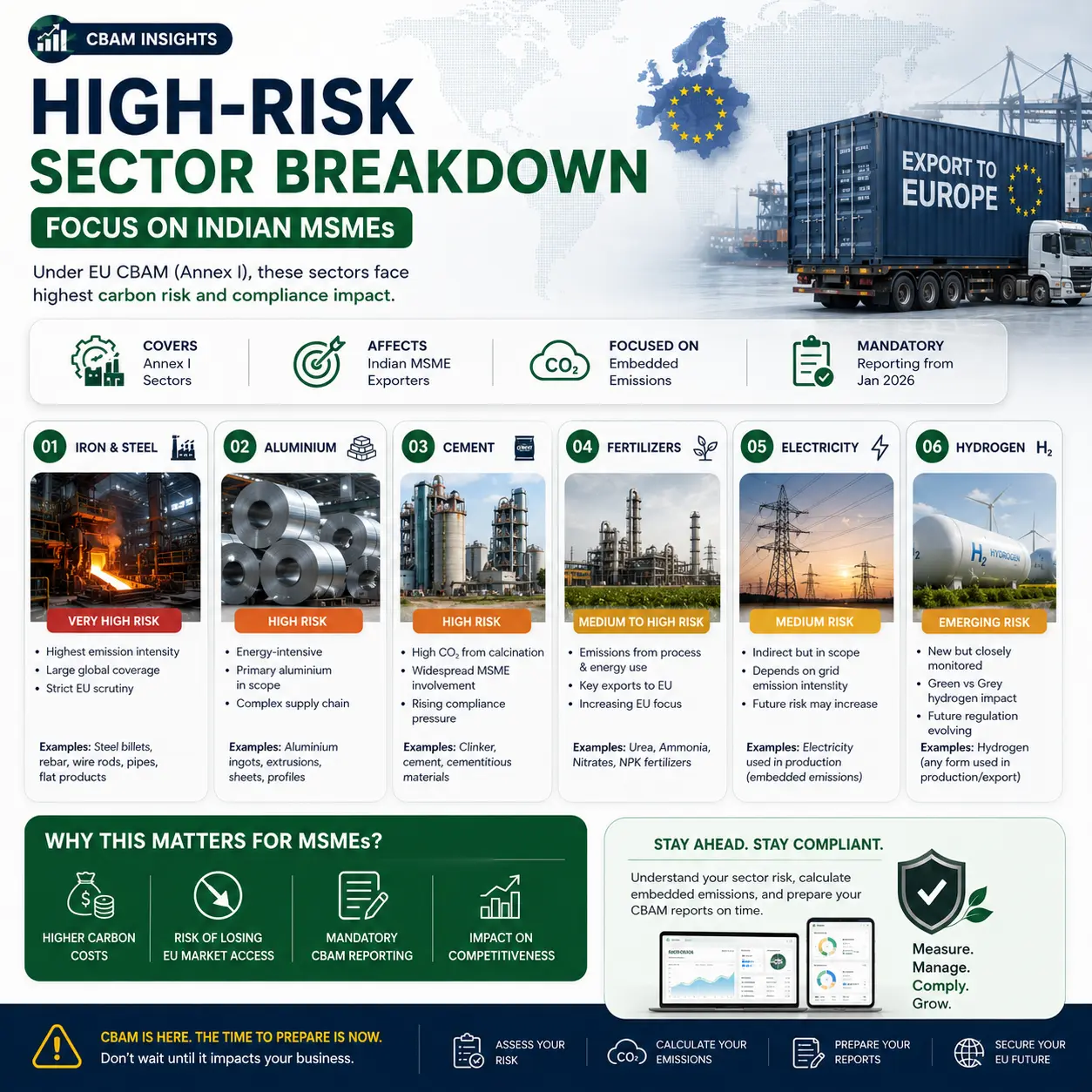
High-Risk Sector Breakdown (Focus on Indian MSMEs)
The Golden Rule of CBAM Coverage
When evaluating compliance risk, Indian exporters often assume that end-use or company size offers a safe harbor. They reason that if a steel flange is destined for a water treatment plant rather than a coal power station, or if it is manufactured in an industrial unit with 25 employees, it should be exempt.
Under EU trade regulations, this assumption is completely false.
Key Rule: CBAM coverage is driven strictly by product classification (8-digit EU CN Code). The intended end-use of the product, the size of your manufacturing facility, your annual turnover, and the legal form of your business play zero role in determining whether a shipment is in scope.
If your exported product’s Combined Nomenclature (CN) code is listed under Annex I of EU Regulation 2023/956, it is subject to CBAM obligations—period.
High-Risk Sector Scope: Indian MSME Risk Matrix
Below is a breakdown of the six primary CBAM sectors, mapped directly against key export commodities from India, their targeted Harmonized System (HS) / Combined Nomenclature (CN) code ranges, and the operational risk level for Indian MSMEs:
| Covered Sector | Key Export Items from India | Targeted HS/CN Code Ranges | MSME Risk Level |
| Iron & Steel | Raw pig iron, billets, slabs, flat-rolled steel, stainless steel bars, rods, and wire | Chapter 72 (7201–7229) | 🔴 Critical |
| Steel Products (Downstream) | Fasteners (screws, bolts, nuts, rivets), pipes, tubes, welded angles, and structures | Chapter 73 (7301–7306, 7318, etc.) | 🔴 Critical |
| Aluminium & Downstream | Unwrought aluminium, alloys, wire, rods, extruded profiles, foil, tubes, and structures | Chapter 76 (7601–7616) | 🔴 Critical |
| Fertilisers | Ammonia, nitric acid, urea, nitrogenous & mixed fertilisers | Chapters 28 & 31 (2808, 2814, 3102, 3105) | 🟡 Medium-High |
| Cement | Cement clinker, Portland cement, aluminous/hydraulic cements | Chapter 25 (2507, 2523) | 🟢 Lower Export Vol. |
| Hydrogen & Electricity | Pure hydrogen gas, electrical energy | 2804 10 / 2716 | ⚪ Niche / Direct |
In-Depth Sector Spotlight for Indian Exporters
1. The Fastener & Hardware Trap (Chapter 73)
The single biggest blind spot for Indian manufacturing clusters—such as those in Ludhiana, Rajkot, Jalandhar, and Pune—lies in Chapter 73 (Articles of Iron or Steel).
Many Tier-2 and Tier-3 suppliers operating under code 7318 (screws, bolts, nuts, coach screws, rivets, washers) assume CBAM only targets primary steelmakers like TATA Steel or JSW. In reality, European lawmakers explicitly added downstream steel goods under Chapter 73 to prevent importers from circumventing primary metal carbon costs by importing finished steel components.
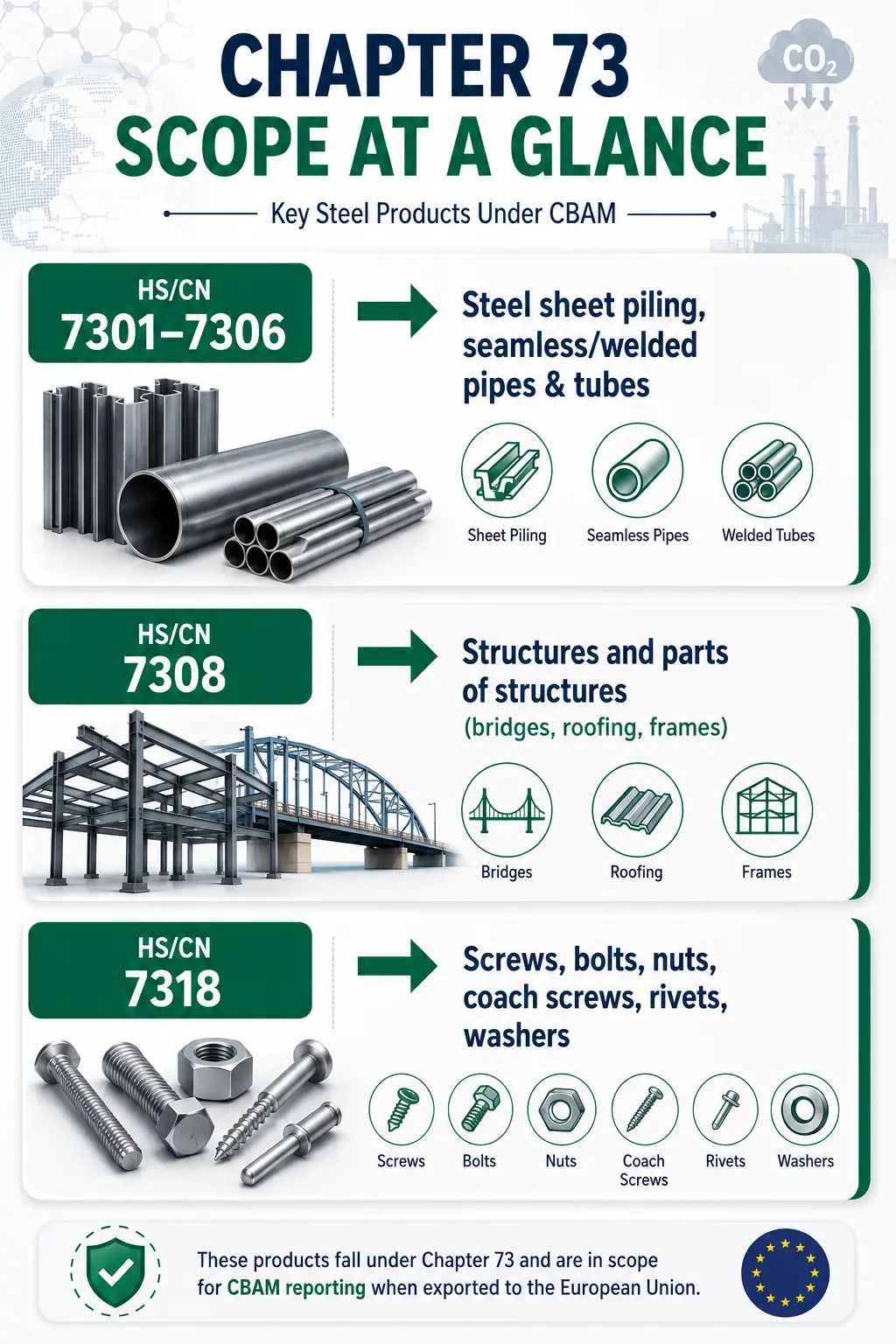
If you forge, cold-head, thread, or package fasteners for European clients, your shipments trigger immediate CBAM compliance. If you fail to supply emissions data, your European buyers face steep financial surcharges based on carbon-intensive default figures.
2. Aluminium Extrusions & Foil (Chapter 76)
India’s aluminium downstream export market to the EU has surged, particularly for extruded profiles, wire rods, auto parts brackets, and packaging foils.
Under Chapter 76, CBAM covers everything from unwrought aluminium (7601) down to finished structures (7610) and miscellaneous articles (7616).
- Auto Component Vendors: If you export machined aluminium housings or brackets under Chapter 76, you must track the carbon intensity of the unwrought metal or billets you purchase.
- Packaging & Foil Manufacturers (7607): Companies converting primary aluminium into thin gauge foils must obtain verified emissions data from their primary smelter suppliers.
3. Crucial Concept: “Simple Goods” vs. “Complex Goods”
Understanding how CBAM measures embedded emissions requires grasping the distinction between Simple Goods and Complex Goods. Most downstream MSME products fall into the “Complex” category.
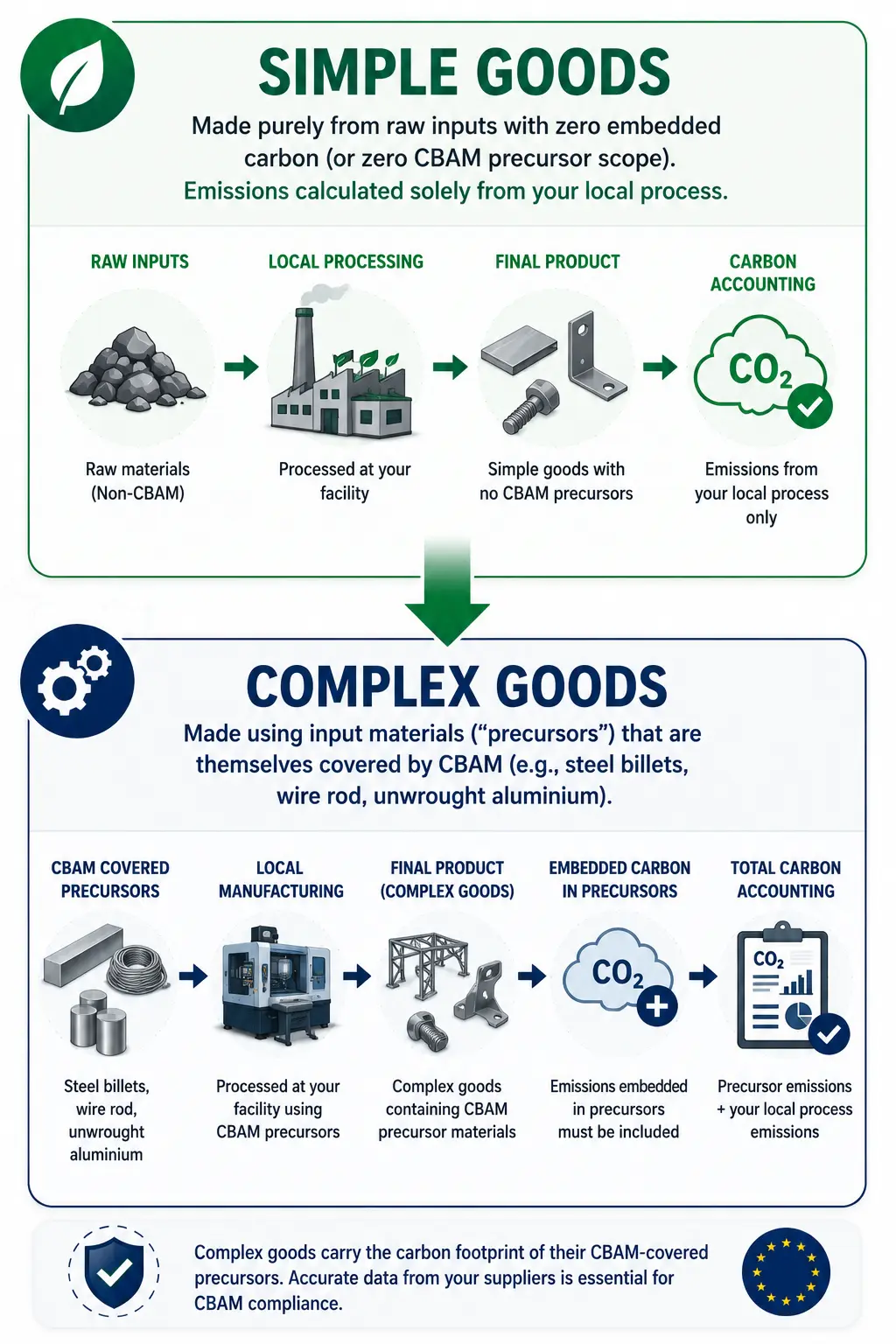
- Simple Goods: Produced using inputs that carry zero embedded carbon under CBAM methodology (e.g., scrap metal or raw ore processed directly in a single integrated facility).
- Complex Goods: Produced using input materials—known as precursors—that are themselves within CBAM scope.
If you run an MSME making steel bolts (7318), your product is a Complex Good. To calculate your final embedded emissions, you cannot simply measure the electricity used by your cold-forging machines. You must combine:
Total Embedded Carbon = Direct Production Carbon + Precursor Carbon (Raw Steel Bar/Rod)
This makes precursor traceability the primary operational hurdle for Indian MSMEs. If your raw steel vendor cannot or will not share their plant-level carbon intensity figures, your downstream product automatically gets penalized with high default carbon rates.
4. Strategic Opportunity: The Scrap Metal & Recycling Advantage
A significant portion of Indian MSME foundries, forge shops, and fastener units operate using Electric Arc Furnaces (EAF) or Induction Furnaces fueled by recycled metal scrap rather than primary virgin iron, billets, or unwrought aluminium.
Under EU CBAM methodology (Annex IV of Regulation 2023/956), post-consumer scrap metal is treated as having zero embedded precursor emissions.
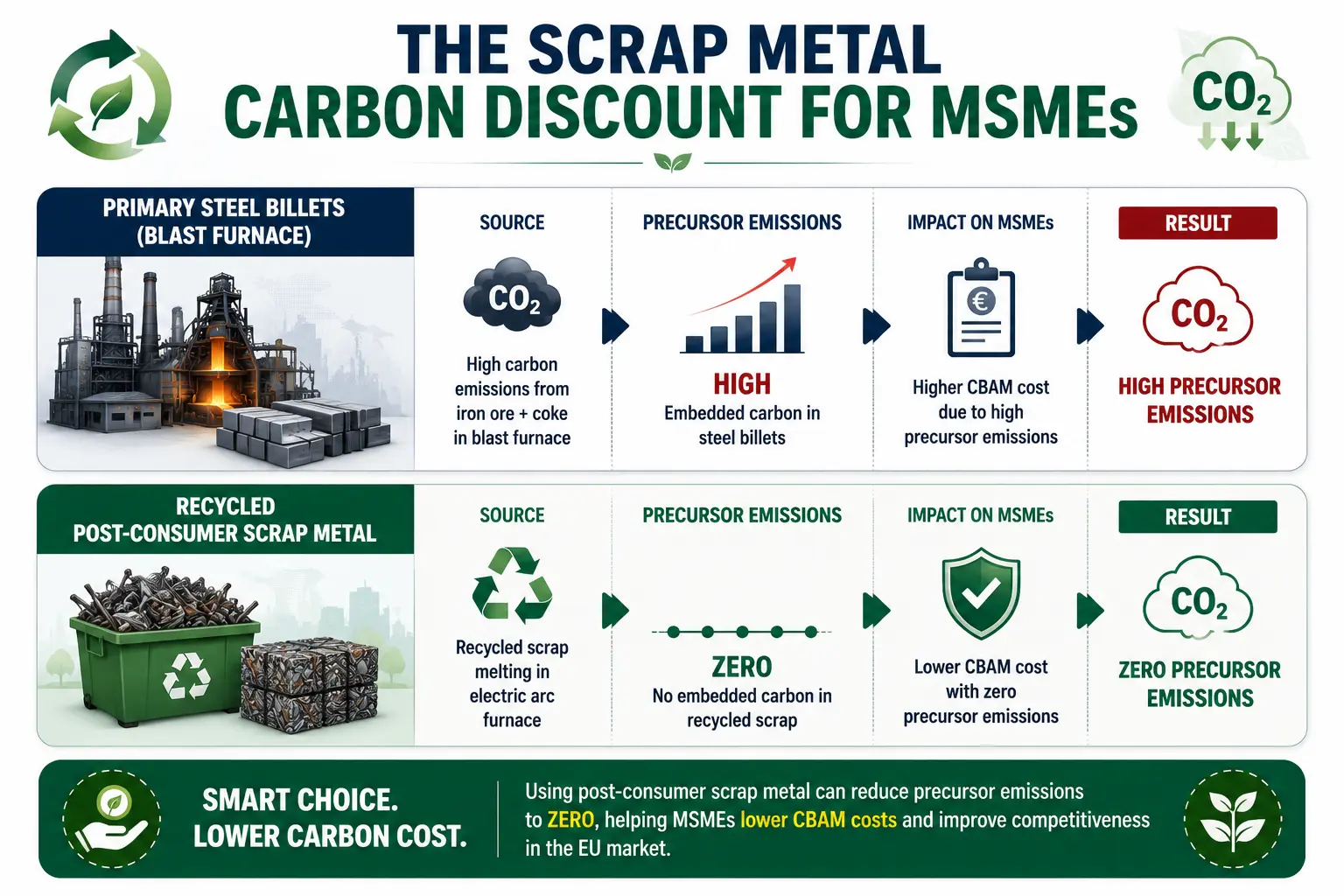
This accounting rule creates a massive competitive wedge for Indian MSMEs:
Massive Emissions Reduction: Since precursor raw materials account for 80%–90% of a complex good’s carbon footprint, using 100% post-consumer scrap slashes your total calculated embedded carbon down to just your local processing energy.
Commercial Advantage: While competitors relying on primary blast-furnace steel face steep CBAM certificate surcharges, scrap-utilizing MSMEs can deliver low-carbon components that keep European buyers’ import tax liabilities minimal.
Traceability Requirement: To claim this advantage, you must maintain strict purchase documentation, scrap classification records, and melt-shop logs proving the proportion of post-consumer scrap used in your production heat cycles.
Step-by-Step: How to Cross-Reference HSN vs.CN Codes
Decoding Trade Systems: HSN vs. CN Codes
A major point of confusion for Indian exporters is the nomenclature difference between Indian shipping documents and European import declarations. To successfully audit your product line, you must understand how these coding systems interact.
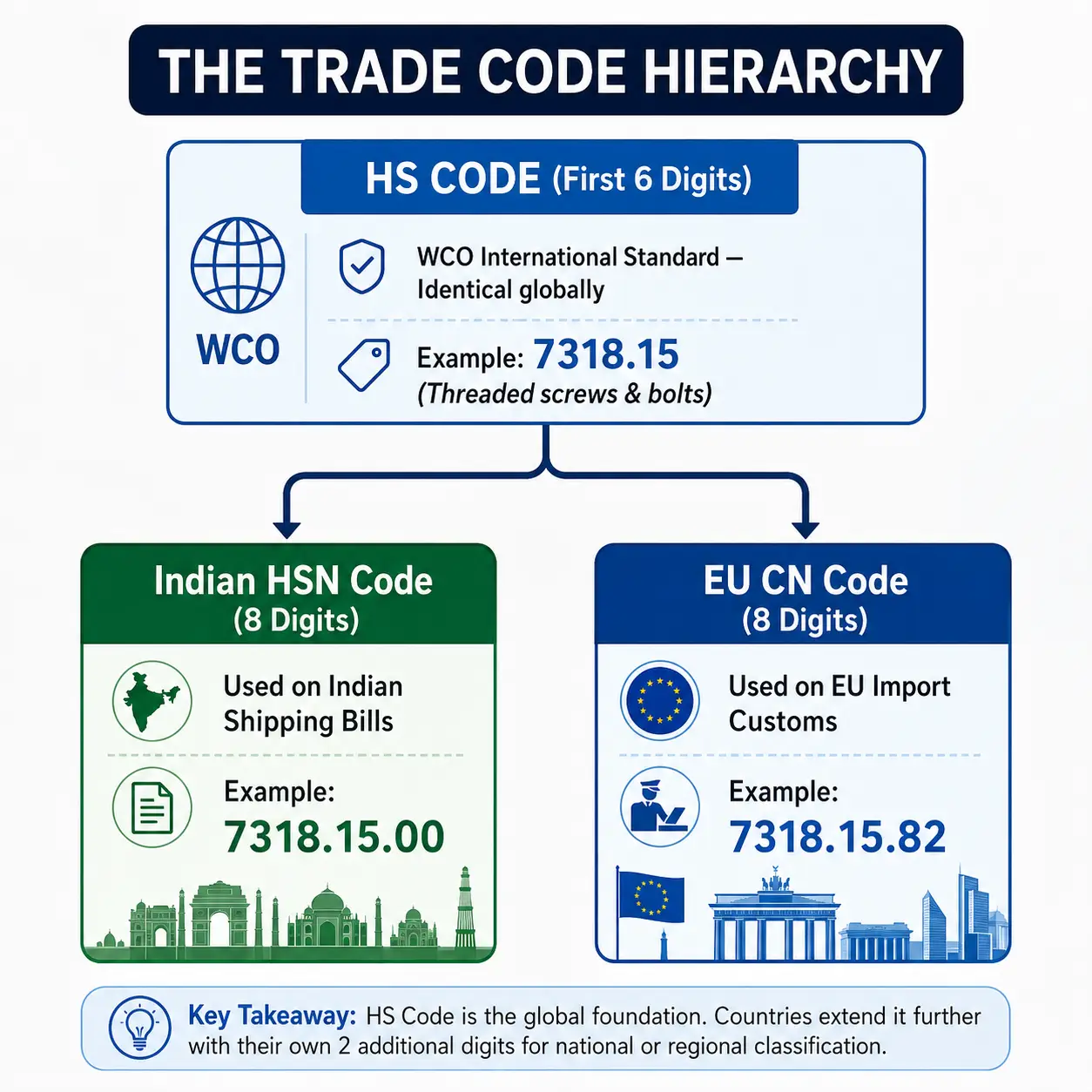
1. The Global Anchor: HS Code (6 Digits)
Developed by the World Customs Organization (WCO), the Harmonized System (HS) code forms the universal baseline of global trade. The first 6 digits of a product code are standardized across all 200+ WCO member nations—including India and all 27 EU member states.
- Example: Heading 7318.15 represents “Other screws and bolts, whether or not with their nuts or washers” anywhere in the world.
2. The Domestic Extension: Indian HSN Code (8 Digits)
India extends the standard 6-digit HS code by adding two additional digits under the Indian Trade Classification (ITC-HS) system to track domestic tariffs and GST.
- Example: 7318.15.00 on your Indian shipping bill or GST tax invoice.
3. The European Target: EU CN Code (8 Digits)
The European Union similarly extends the 6-digit WCO code using its Combined Nomenclature (CN) system. The 8-digit CN code is what your European importer declares on their customs entry documents, and it is the exact tariff key used in Annex I of the CBAM Regulation.
- Example: 7318.15.82 (“Screws and bolts, without heads, of stainless steel”).
The 3-Step Matching Process
Because CBAM scope is defined at the 8-digit EU CN level, you cannot assume an exact 8-digit match between your Indian invoice and EU customs documents. Instead, follow this mandatory 3-step audit process:
Step 1: Extract the First 6 Digits of Your Indian HSN
Look at your current Shipping Bills, Bills of Lading, or GST invoices. Isolate the first 6 digits of the HSN code for each product you export to the EU.
- Example: If your Indian shipping document states HSN 7604.29.10 (Aluminium alloy bars and rods), extract the global 6-digit root: 7604.29.
Step 2: Open Annex I of EU Regulation 2023/956
Access the official text of Annex I of Regulation (EU) 2023/956 (the legal list of goods covered under CBAM). Search the document for your 6-digit root heading (7604.29).
Step 3: Match the 8-Digit Subheadings
Check if the EU CN codes listed under that 6-digit heading encompass your specific product description.
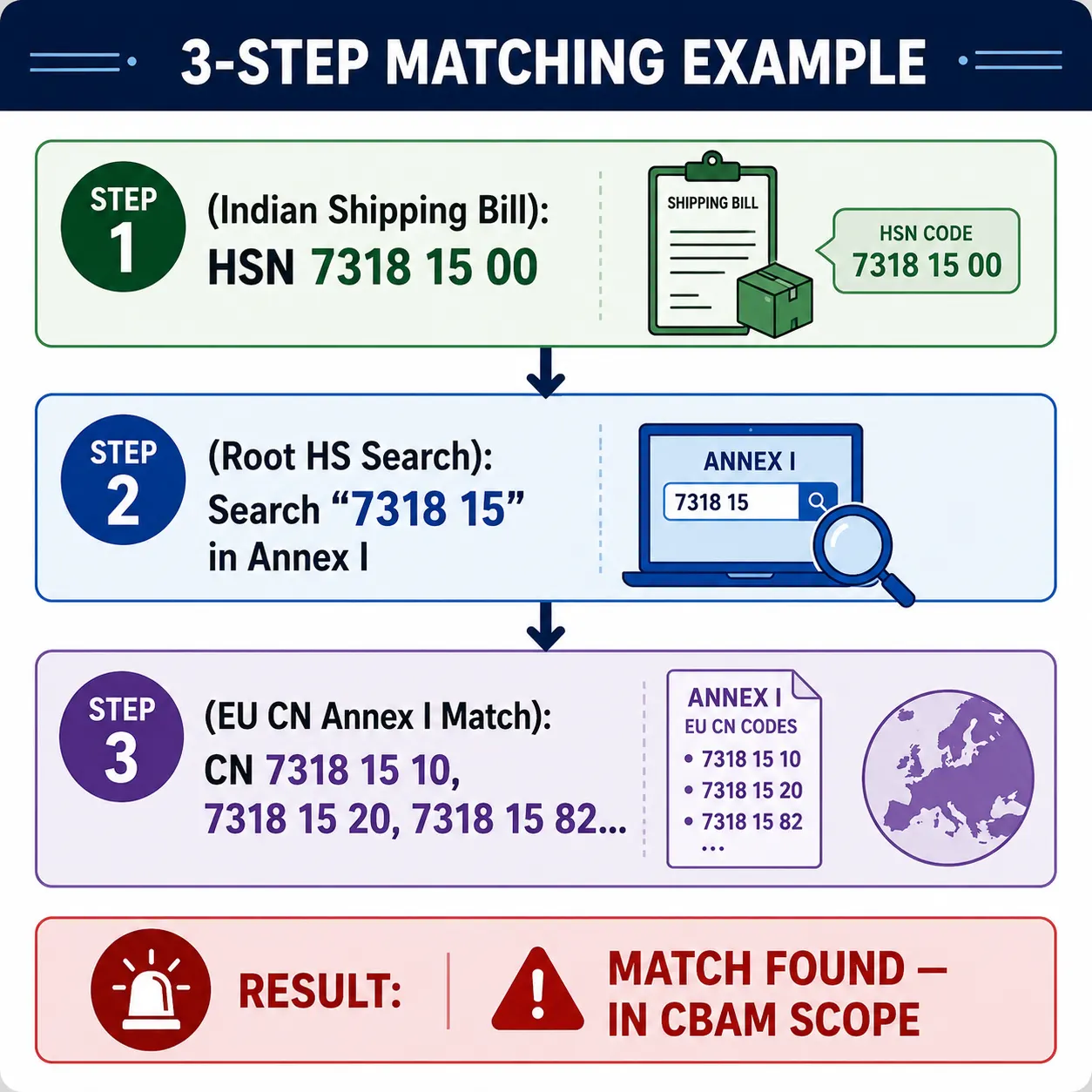
If your product’s 6-digit heading appears in Annex I and its 8-digit breakdown covers your product material, your product is in scope.
Watch Out for Exemptions and Threshold Rules
While CBAM scope is broad, specific statutory exemptions exist. Keep these critical boundaries in mind:
1. Small Consignment Thresholds
- The €150 De Minimis Rule: Consignments where the total intrinsic value of the CBAM-covered goods does not exceed €150 per shipment are automatically exempt from CBAM reporting and surcharges.
- Important Caution: The €150 threshold applies to the cumulative value of all CBAM goods in a single shipment. If you ship a consolidated crate containing €200 worth of fasteners, the entire consignment triggers CBAM requirements.
Critical Threshold Update: The 50-Tonne Importer Exemption:
> Under the EU’s streamlined CBAM rules, an aggregate 50-tonne annual threshold applies to importers of iron, steel, aluminium, cement, and fertilisers.
>Who Is Exempt: Importers whose total annual combined volume of covered basic/raw metal goods remains at or below 50 tonnes net mass per calendar year do not need to register as an Authorised CBAM Declarant or surrender carbon certificates.
>The Catch for MSMEs: This 50-tonne threshold is calculated cumulatively per EU importer across all their suppliers, not per individual shipment or per exporter.
>Action Required: If your European buyer imports goods from multiple suppliers, your shipment—even if small—will likely push them over their aggregate 50-tonne limit. Once crossed, all shipments from that importer for the year fall into CBAM scope. Always confirm with your buyer whether they operate above or below this limit!
2. Military and Defense Goods
Goods imported strictly for military operations, national defense use, or under specific international defense agreements are exempt from CBAM scope under Article 2 of the regulation.
3. Returned or Re-imported Goods
Products originating within the EU that are returned to the EU without substantial transformation in third countries generally fall outside CBAM obligations, provided customs documentation validates their origin.
Interactive Scope Checker (Flowchart Logic for Readers)
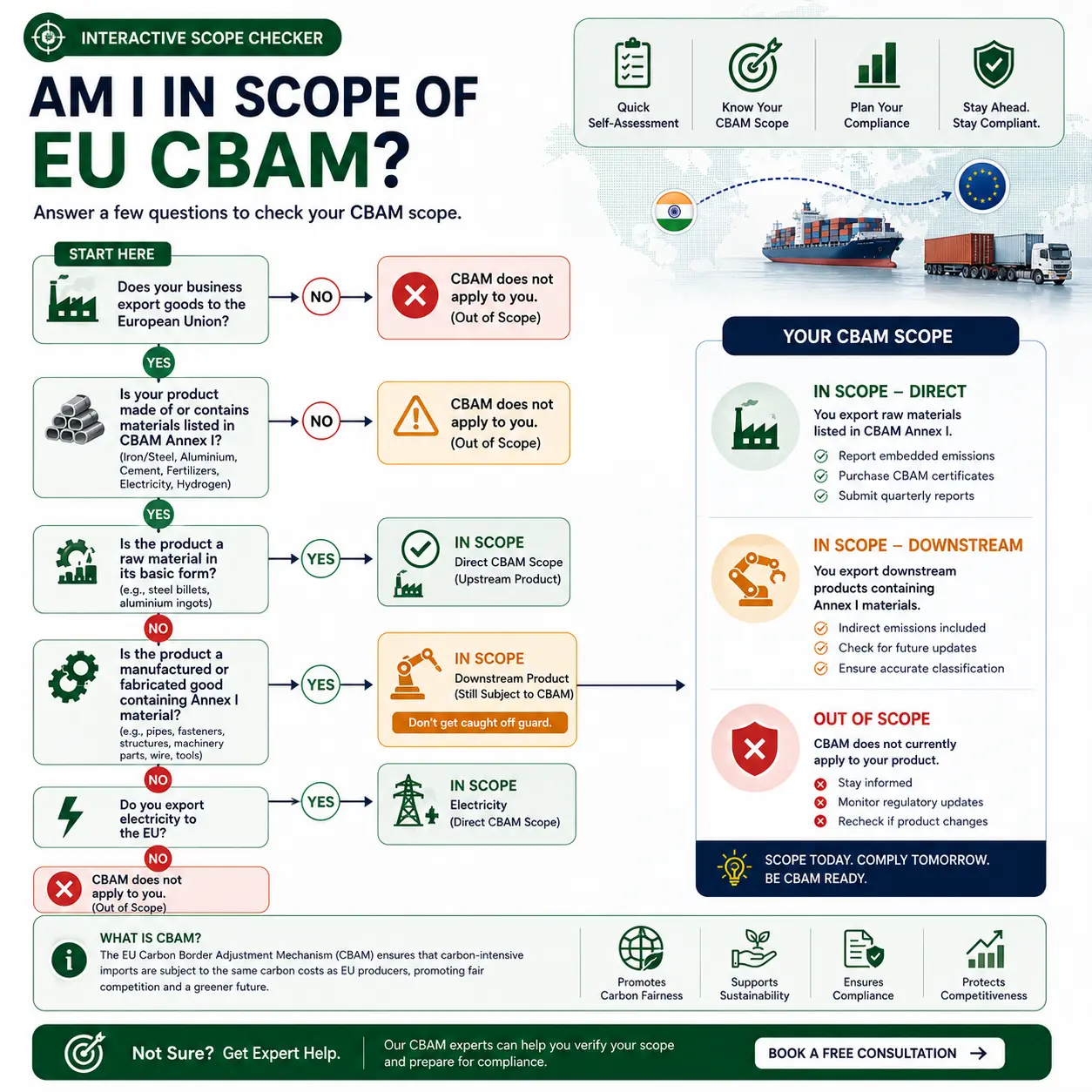
The Decision Tree: Are Your Exports Under CBAM?
To streamline your compliance audit, use the decision logic below. This flowchart maps the step-by-step verification process an Indian exporter must execute before sending commercial shipments to any European Union destination.
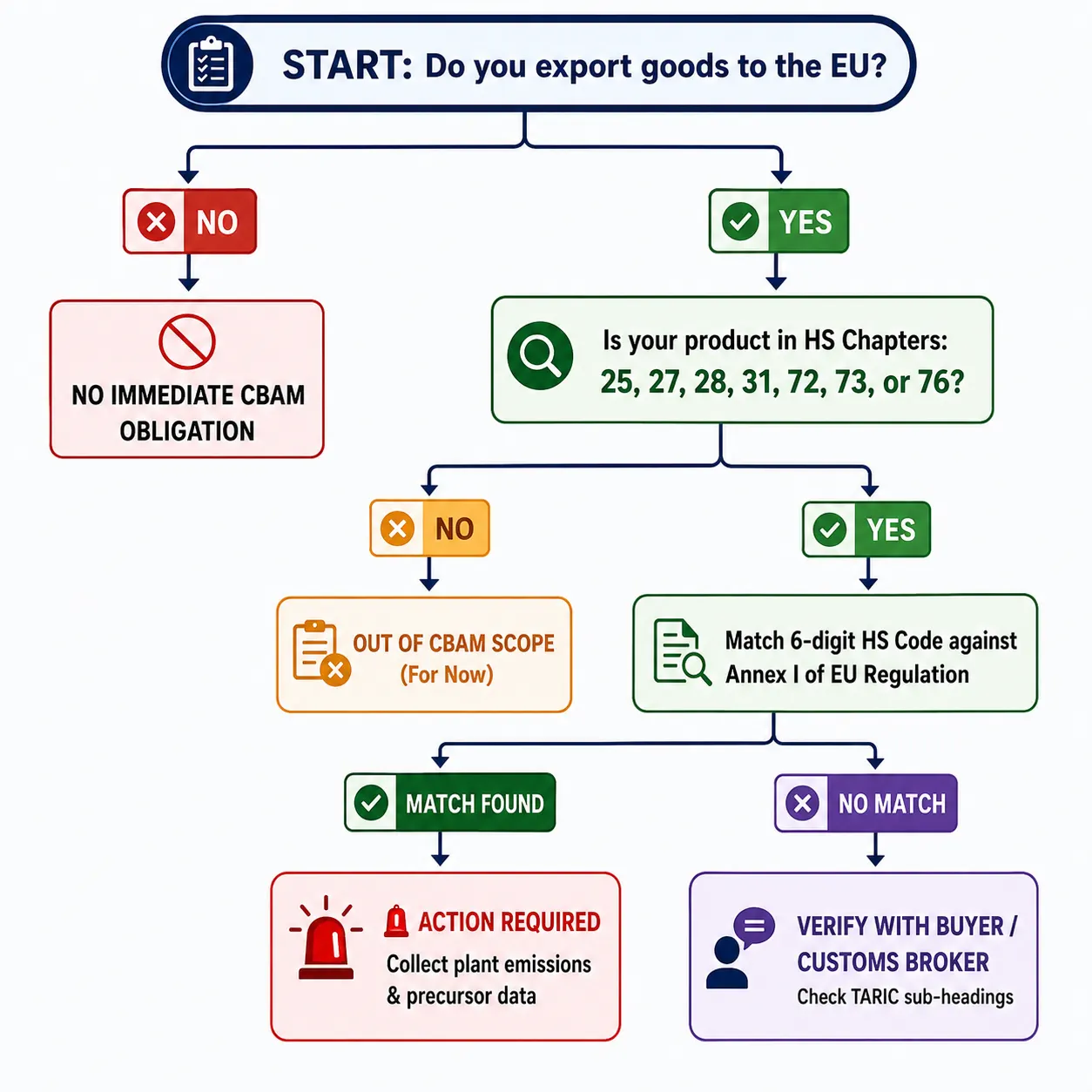
Step-by-Step Flowchart Breakdown
Step 1: Export Destination Check
- Question: Does your company export directly or indirectly (via trading houses) to any of the 27 EU member states?
- Outcome – NO: No immediate action required. However, if your domestic customer uses your components in finished goods exported to the EU, they may eventually request precursor data.
- Outcome – YES: Move to Step 2.
Step 2: Broad Chapter Screening
- Question:Does your Indian Shipping Bill HSN code fall under any of these primary chapters?
- Chapter 25: Cement, Clinker
- Chapter 27: Electrical Energy
- Chapter 28: Pure Hydrogen, Inorganic Chemicals, Nitric Acid, Ammonia
- Chapter 31: Fertilisers (Urea, Nitrogenous mixtures)
- Chapter 72: Primary Iron & Steel, Stainless Steel
- Chapter 73: Articles of Iron or Steel (Pipes, Fasteners, Structures)
- Chapter 76: Aluminium and Articles thereof (Unwrought metal, Wire, Profiles, Foil, Tubes)
- Outcome – NO: Your product is currently Out of Scope. (Note: Monitor European Commission scope updates, as additional downstream products are reviewed periodically).
- Outcome – YES: Move to Step 3.
Step 3: Annex I CN Code Audit
- Question: Does the 6-digit root of your Indian HSN code explicitly match an 8-digit CN code listed in Annex I of Regulation (EU) 2023/956?
- Outcome – MATCH FOUND (🚨 ACTION REQUIRED): Your product is In Scope. You must immediately begin compiling plant-level direct emissions (Scope 1) and indirect electrical emissions (Scope 2), alongside precursor data from raw material suppliers.
- Outcome – NO MATCH: Your 6-digit heading may be exempt, or categorized differently under EU customs. Re-verify the precise 8-digit Combined Nomenclature (CN) code used on entry clearance documents with your EU buyer or European customs broker.
Immediate Action Plan for Affected MSMEs
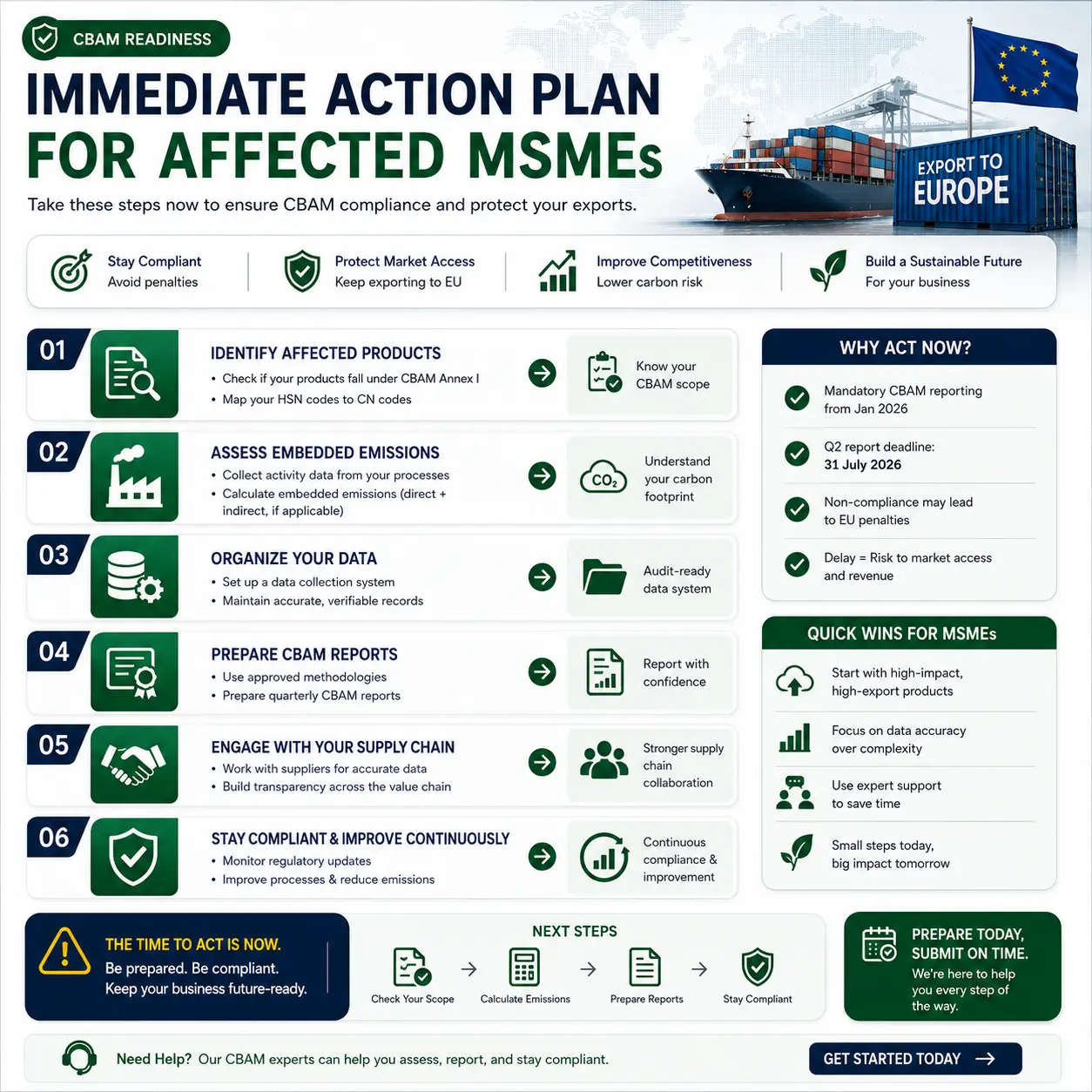
Moving from Awareness to Action: The MSME Compliance Roadmap
With CBAM now active, relying on default values is no longer a viable strategy for long-term competitiveness. Because default values incur high punitive surcharges, European buyers will prioritize suppliers capable of delivering accurate, installation-level embedded emissions data.
If your product line falls under Annex I, execute this three-step operational roadmap to protect your export margins and retain your European customer relationships.
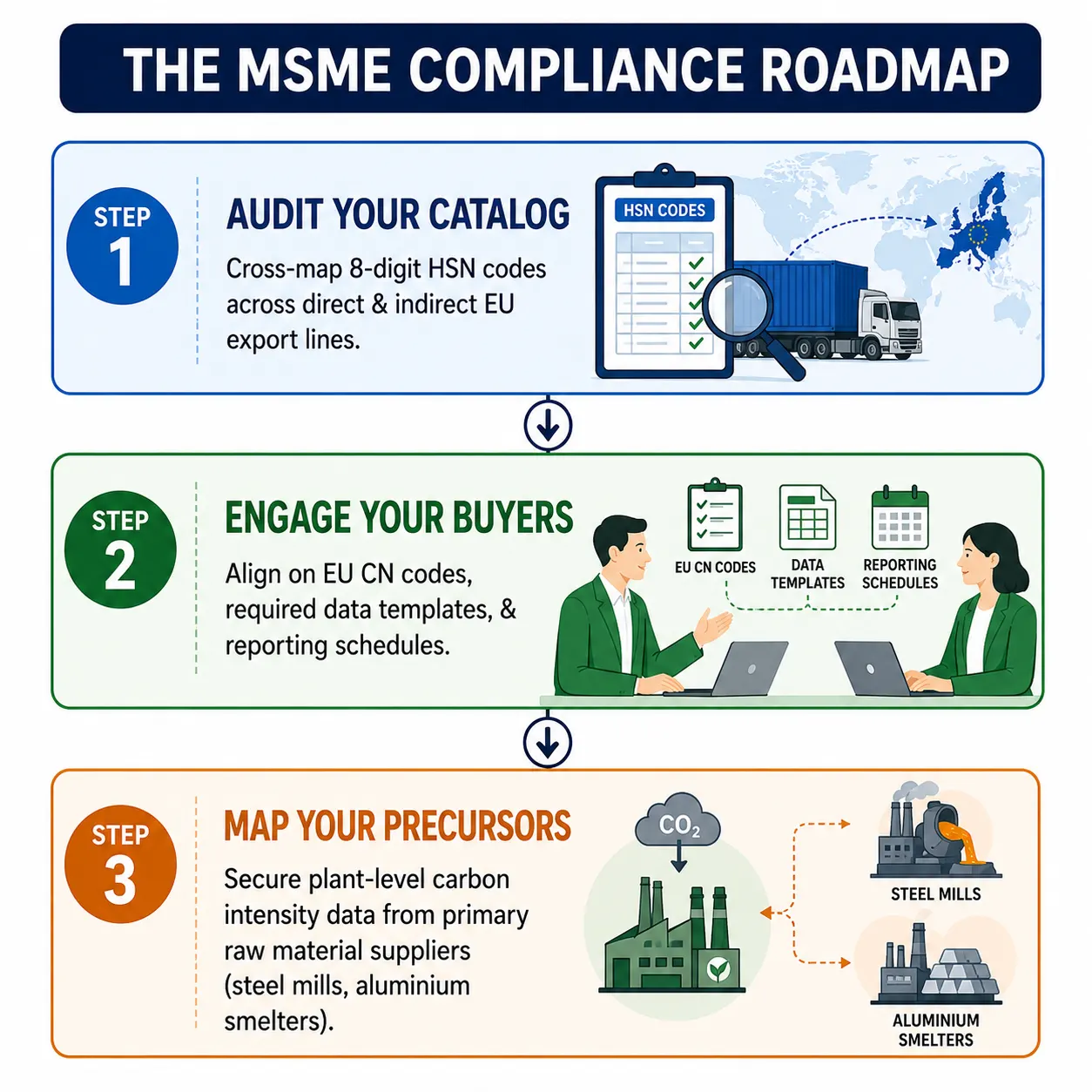

Step 1: Audit Your Catalog (Direct & Indirect Scope)
Do not limit your audit to finished goods exported directly to Europe. Conduct a comprehensive product-line screening across your entire manufacturing catalog:
- Direct Exports: Screen every item shipped under your own IEC (Import Export Code) to European destinations.
- Indirect Exports (Domestic Supply Chains): Audit sales to domestic Indian OEMs, trading houses, or Tier-1 exporters. If your domestic buyers assemble your components into finished goods bound for the EU, they will require your precursor data.
- Compile a Code Master Sheet: Create a standardized inventory listing every product, its Indian 8-digit HSN code, its corresponding EU 8-digit CN code, its primary raw material composition, and its current CBAM status (In-Scope vs. Out-of-Scope).
Pro Tip: If a single product variant uses different raw material grades (e.g., cold-rolled vs. hot-rolled steel bars), list them as separate items. Different material grades carry vastly different precursor carbon profiles.
Step 2: Proactively Engage Your EU Buyers
Do not wait for an urgent request or a held-up customs clearance to contact your European procurement managers. Initiate contact proactively to clarify four operational details:
- Exact CN Code Alignment: Confirm the specific 8-digit Combined Nomenclature (CN) code their European customs brokers use to clear your shipments.
- Required Reporting Format: Request the specific data reporting format or portal template preferred by their Authorised CBAM Declarant. (While the EU provides a standard communication template, many large European buyers utilize automated third-party carbon accounting platforms).
- Reporting Frequency & Deadlines: Establish clear schedules for data delivery.
- Verification Requirements: Ask whether your buyer requires independent third-party verification of your facility’s emissions data.
Guidance Note: “Exporters do not have to navigate this alone. Export promotion councils like EEPC India regularly conduct CBAM technical workshops and offer compliance guidance for engineering MSMEs. Check with your industry export council for standard calculation sheets before hiring third-party consultants.”
Step 3: Identify & Track Your Precursors
For downstream engineering MSMEs, over 80% of a finished product’s embedded emissions typically originate in the raw material stage (the precursor). Your internal manufacturing emissions (machining, stamping, heat treatment) account for only a small fraction of the total footprint.
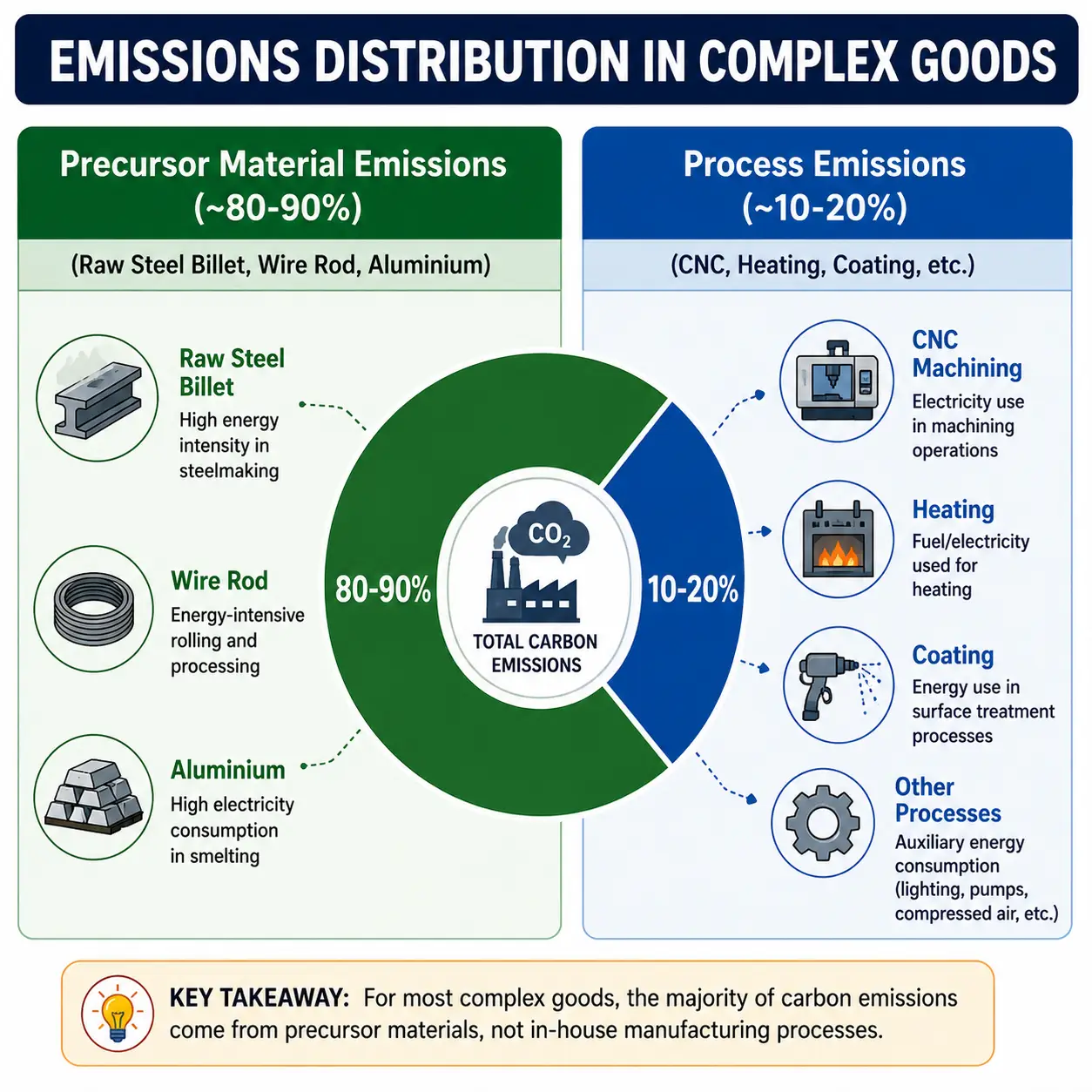
To provide compliant calculations for complex goods, you must request supplier metrics for all raw material purchases:
- Request Plant-Level Data: Demand specific, verified Scope 1 and Scope 2 emission figures (tCO2e/t per tone of metal) from your primary steel mills or aluminum smelters.
- Procurement Documentation: Ensure your procurement team secures carbon intensity declarations alongside standard Mill Test Certificates (MTC) for every batch of raw metal purchased.
- Supplier Diversification: If a raw material vendor cannot or will not provide verifiable emissions data, begin sourcing from compliant mills. Continuing to buy unverified raw metal forces your product to be evaluated using punitive default values, undermining your pricing advantage in the EU market.
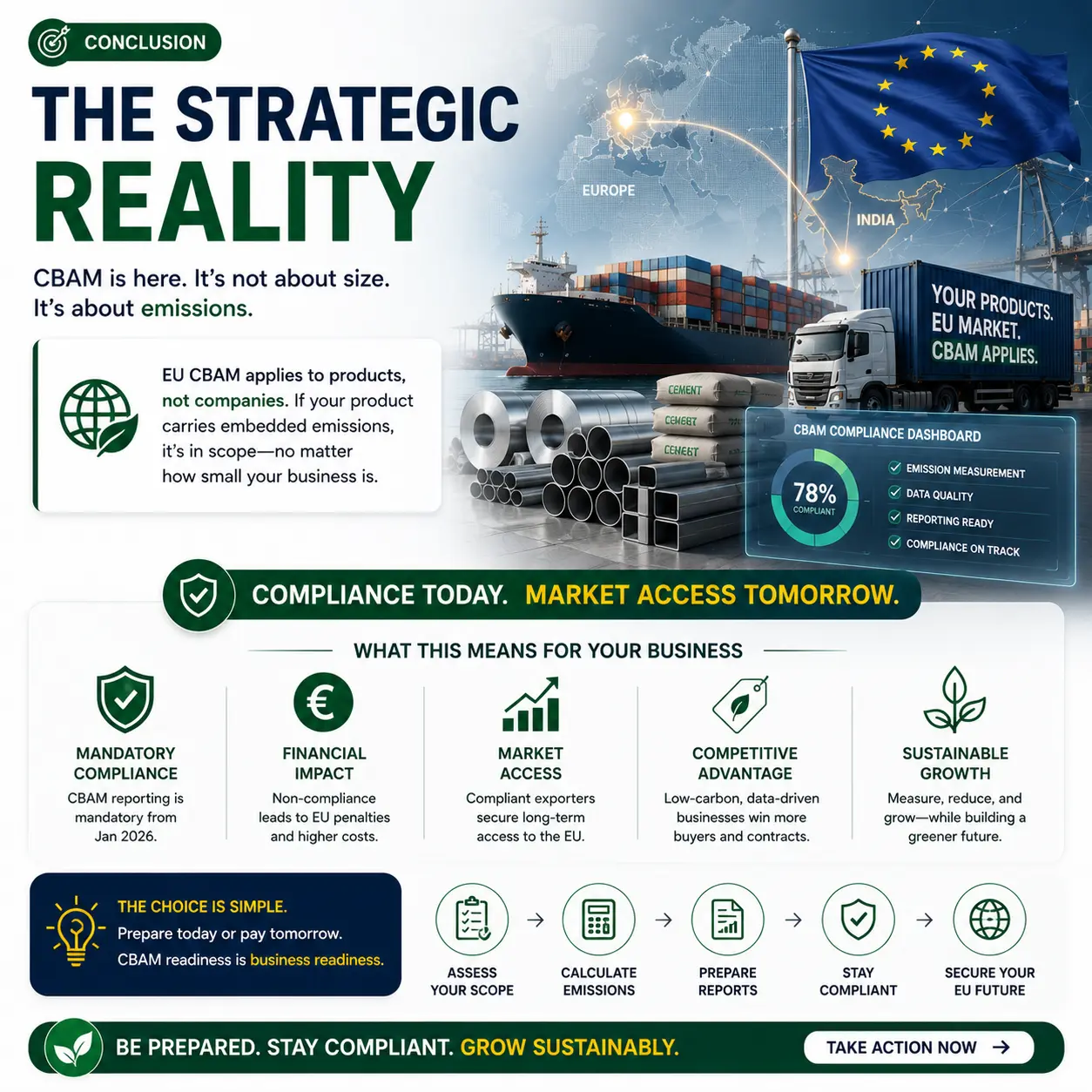
Conclusion: The Strategic Reality
Scope Awareness Is Your Export Shield
Navigating the European Union’s Carbon Border Adjustment Mechanism does not require a degree in environmental law, but it does demand absolute operational clarity on product classification.
The single biggest mistake an Indian MSME can make is assuming that company size, manufacturing volume, or downstream value-addition shields them from compliance obligations. In the post-2026 CBAM definitive era, product scope is king. If your goods fall under the targeted 8-digit EU CN codes in Annex I, your access to the European market is directly tied to your ability to provide carbon data.
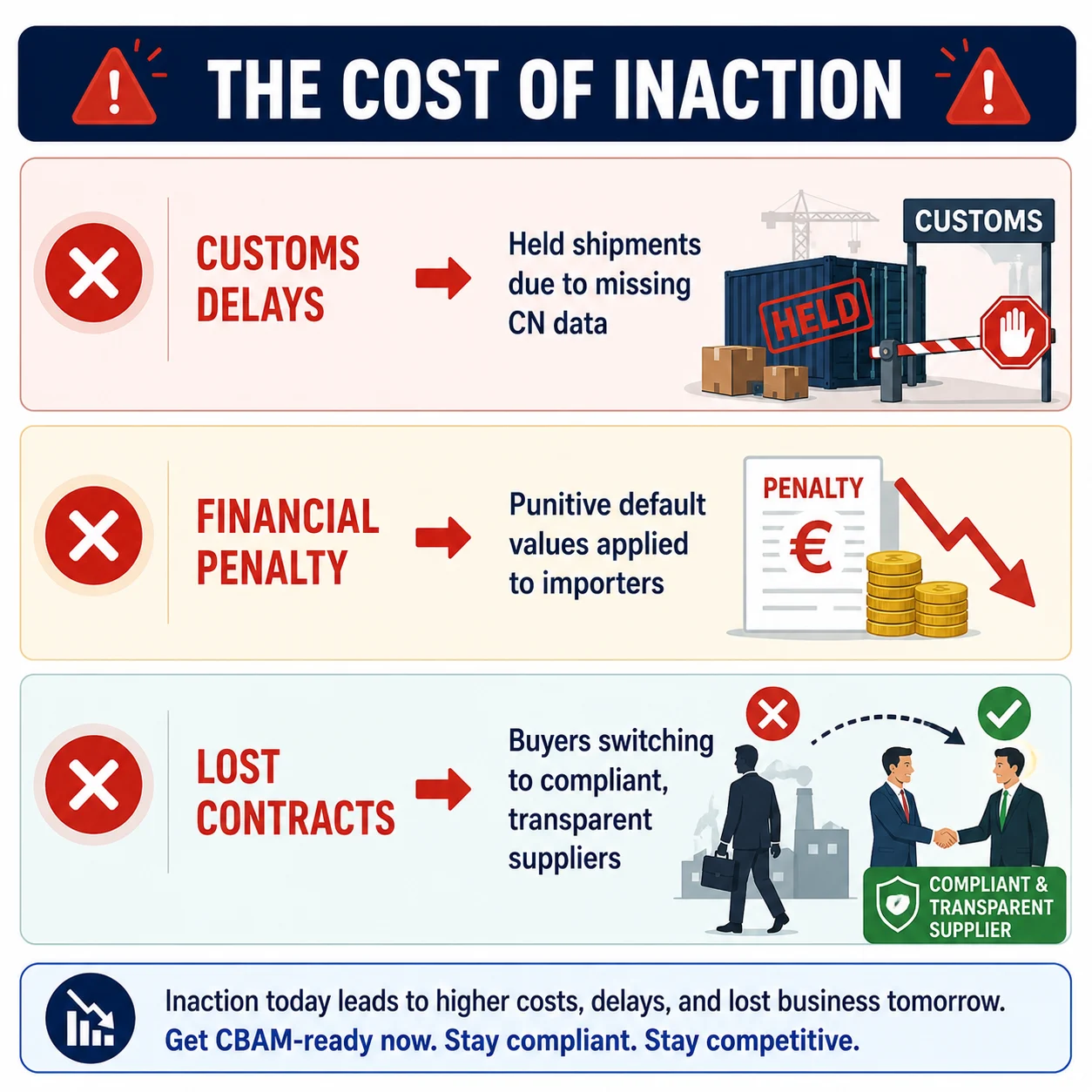
Ignorance of Annex I scope is no longer an administrative footnote—it is the fastest route to supply chain friction, penalty-rate default surcharges, and lost export contracts in the EU. By auditing your HSN catalog today, identifying your precursor dependencies, and aligning with your European buyers, you transform a daunting regulatory hurdle into a lasting competitive advantage.
What Comes Next?
Teaser for your next Article: “Now that you know your product is affected, how do you actually calculate its embedded emissions? In the next article, we break down Direct vs. Indirect emissions and show you how to collect plant-level data without paying for expensive software.”
In 60 minutes, we will review your export profile, assess your CBAM exposure, and recommend the right compliance strategy.



One Comment