
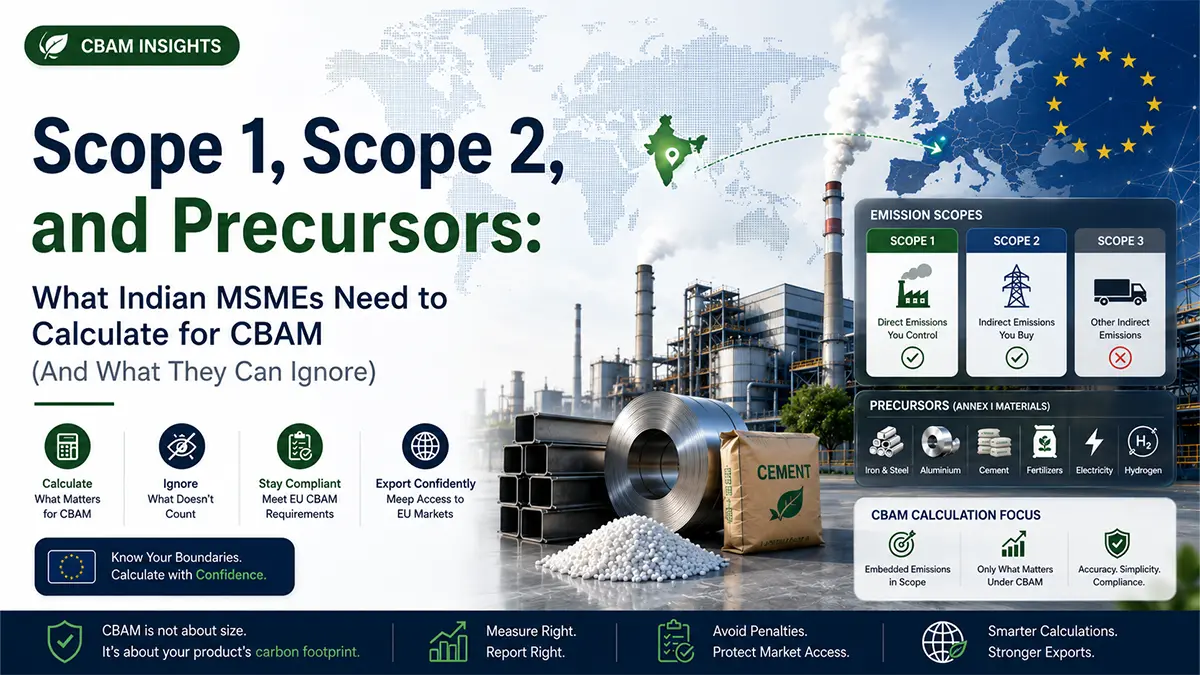
Scope 1, Scope 2, and Precursors: What Indian MSMEs Need to Calculate for CBAM (And What They Can Ignore)

Why CBAM Jargon Confuses Exporters
If you are an Indian manufacturer exporting steel, aluminum, or iron products to Europe, your inbox has likely been flooded with corporate buzzwords: Scope 1, Scope 2, Scope 3, GHG Protocol, Carbon Footprints, and Specific Embedded Emissions.
To a plant manager or MSME business owner running a lean shop floor, this terminology sounds like an invitation to hire an expensive enterprise sustainability team or an international consulting firm.
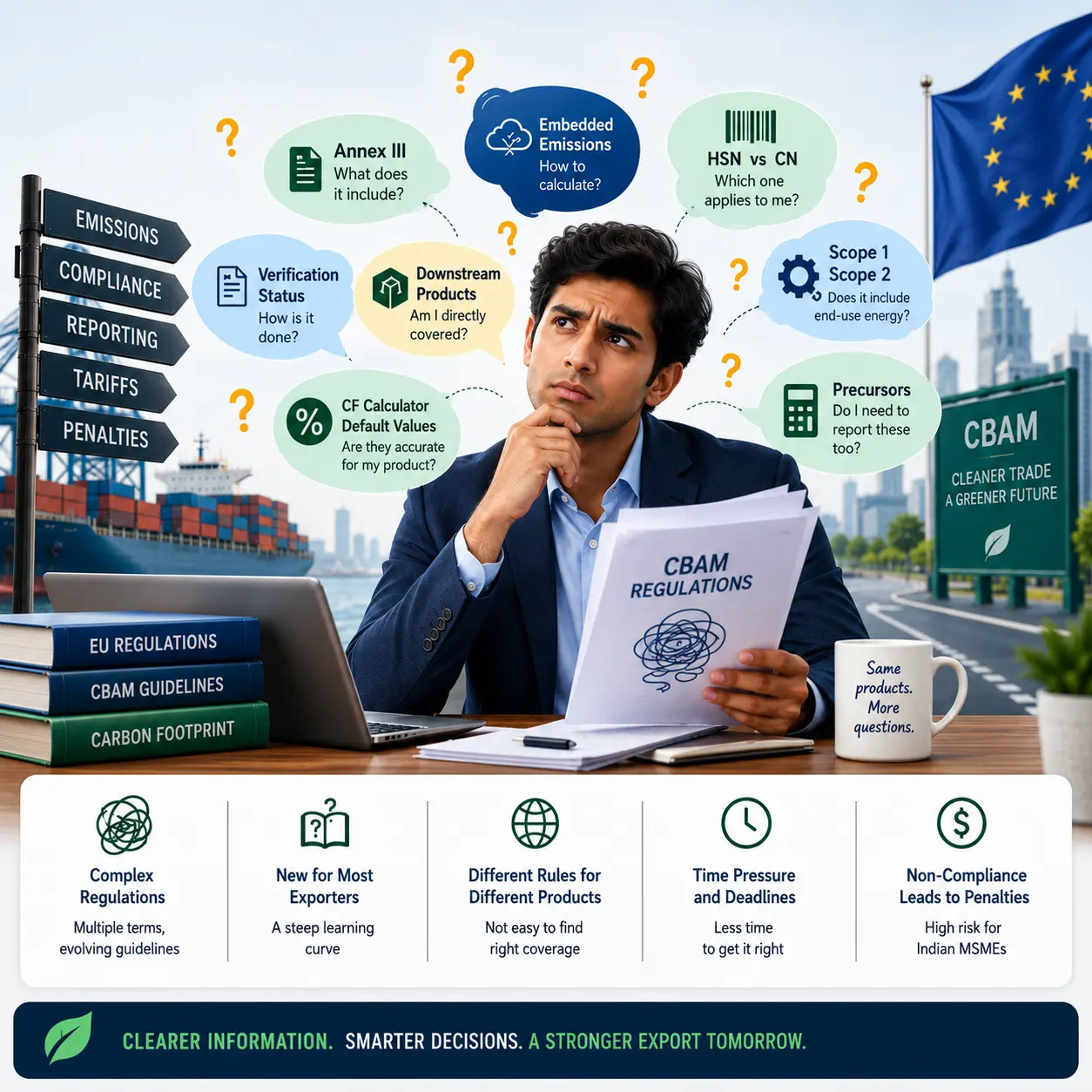
The Problem: Confusing Corporate Carbon Accounting with Product Reporting
Most carbon accounting frameworks—like standard ESG reporting or ISO 14064—are designed for entire corporations. They expect you to track everything from the electricity used in your administrative office’s air conditioners to the fuel burned by your sales representatives’ cars.
When Indian exporters look at these massive standards, the task feels overwhelming, expensive, and irrelevant to daily manufacturing operations.
The Reality: CBAM Cares About Products, Not Corporate Footprints
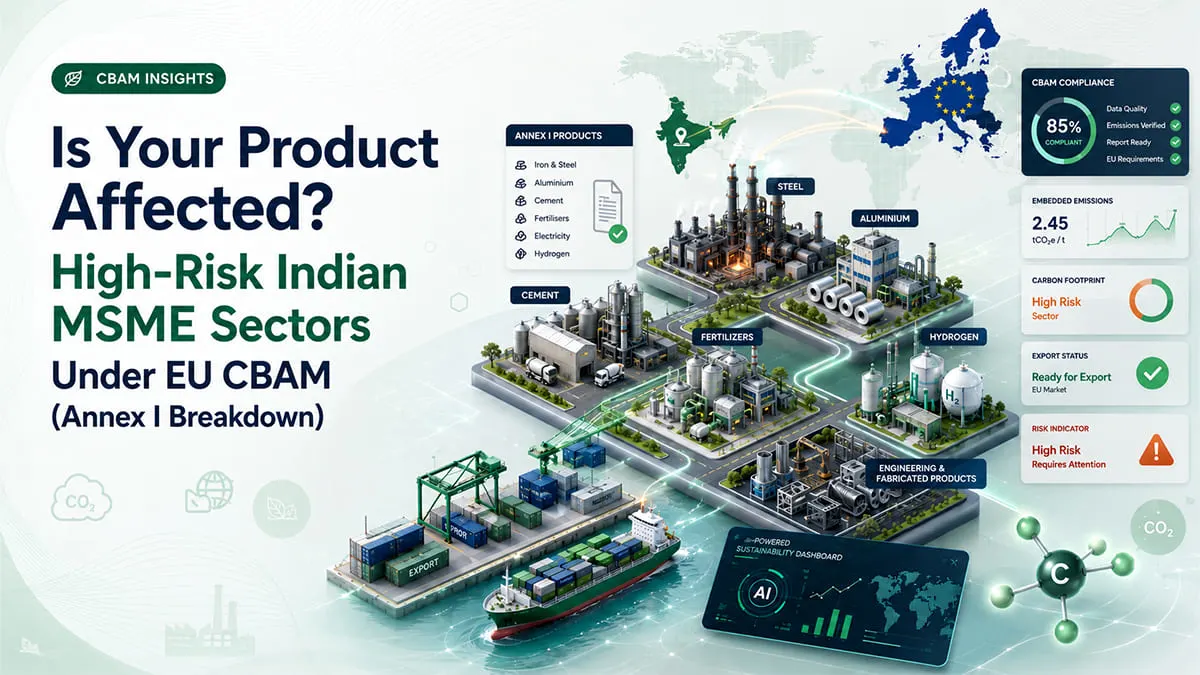
The European Union’s Carbon Border Adjustment Mechanism (CBAM) operates on a much narrower, highly specific scope. CBAM does not require a full corporate ESG audit.
Instead, CBAM is interested strictly in product-level embedded emissions within defined “system boundaries.” In simple terms: the EU only wants to know the direct energy and material inputs that physically went into producing a specific tonne of steel, aluminum, or downstream goods (like fasteners or pipes) exported to Europe.
The Promise: What You Need vs. What You Can Ignore
You do not need an enterprise-grade sustainability department to comply with CBAM. You simply need a clear understanding of what happens on your factory floor and the right system to format that data.
This guide strips away the academic jargon. We will break down exactly which numbers you must gather from your utility bills, fuel logs, and raw material invoices—and reveal the long list of corporate emissions you can safely ignore.
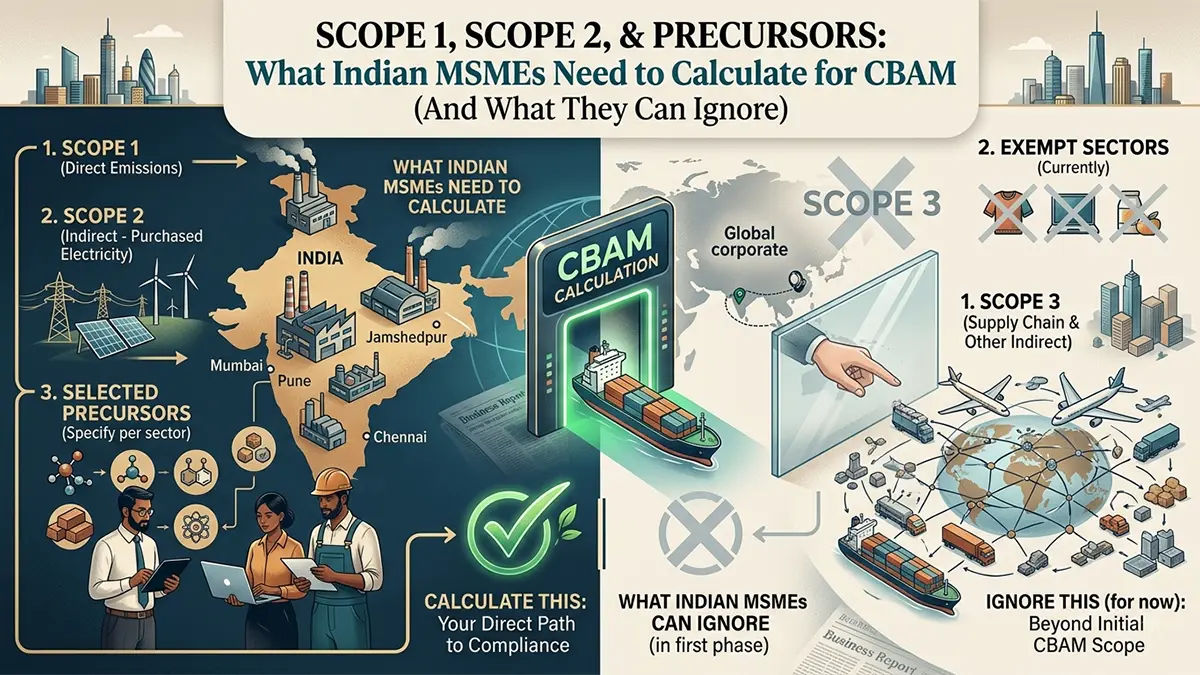
Scope 1 — Direct Emissions on Your Factory Floor
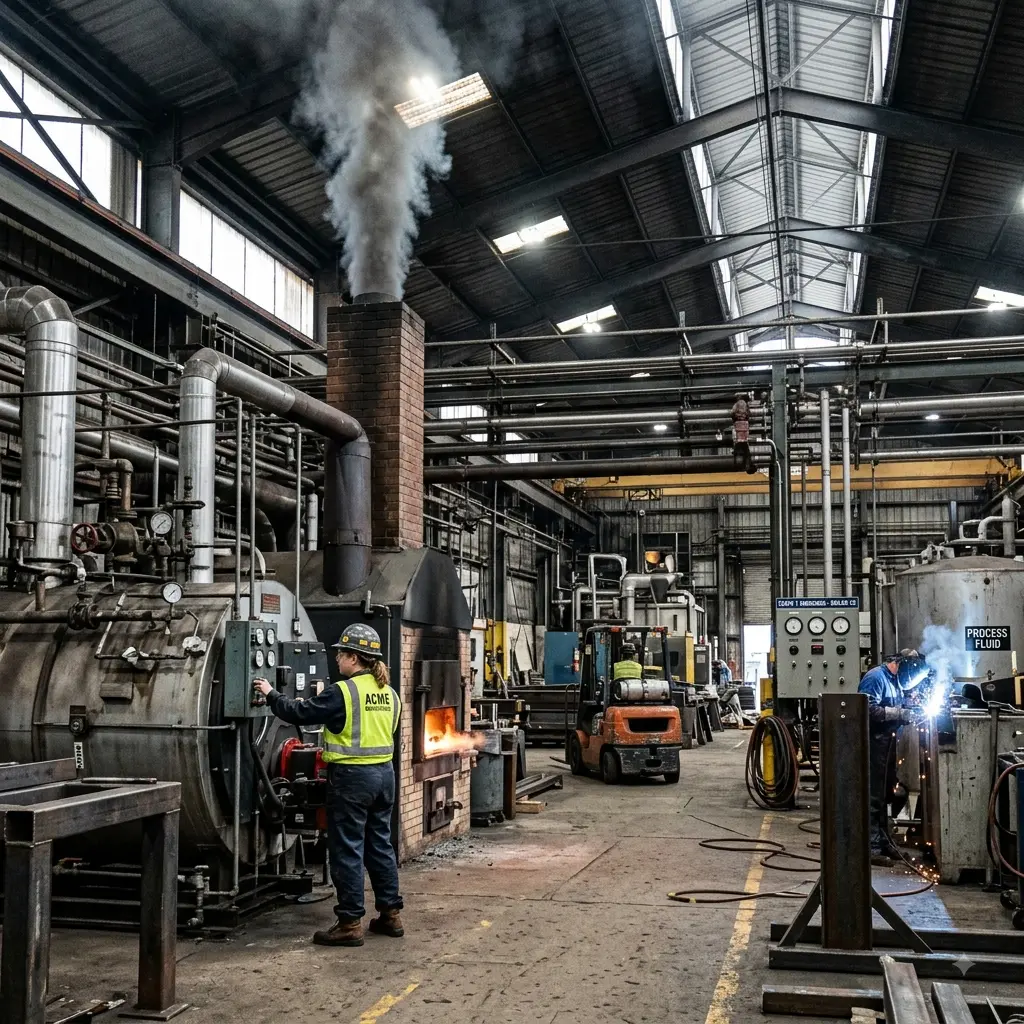
Scope 1 emissions represent the greenhouse gases released directly into the atmosphere from equipment or activities owned and operated within your factory premises. Under CBAM rules, these are your “direct embedded emissions.”
For an Indian manufacturing plant, Scope 1 is not an abstract calculation—it directly tracks the physical fuels burned to run your production line, generate heat, or maintain operations during grid power outages.
Common Scope 1 Sources in Indian MSMEs
Depending on your production processes, your Scope 1 inputs generally fall into three main categories:
- Stationary Combustion (Furnaces, Boilers & Kilns): Fuel burned on-site to generate steam or high-temperature heat. Common sources include Furnace Oil (FO), Light Diesel Oil (LDO), Liquefied Petroleum Gas (LPG), Natural Gas, or Coal used in reheating furnaces, foundries, or casting units.
- Backup Power Generation: Diesel Generator (DG) sets used during power outages or peak-load shaving. The diesel consumed while running production machinery during a blackout counts toward your product’s direct emissions.
- Process Emissions: Chemical reactions occurring during production that release carbon dioxide independent of fuel burning (such as the calcination phase in cement or specific chemical reduction steps in metal smelting).
What Data You Need to Collect
To calculate your Scope 1 emissions, you do not need complex sensor networks. You need accurate operational logs showing fuel consumption allocated to the manufacturing period:
- Monthly fuel purchase invoices and inventory logs (litres of diesel, kilograms of LPG, or tonnes of coal).
- DG set logbooks detailing running hours and fuel filled.
- Meter readings for natural gas or piped fuel lines.
Section III: Scope 2 — Indirect Emissions from Purchased Electricity
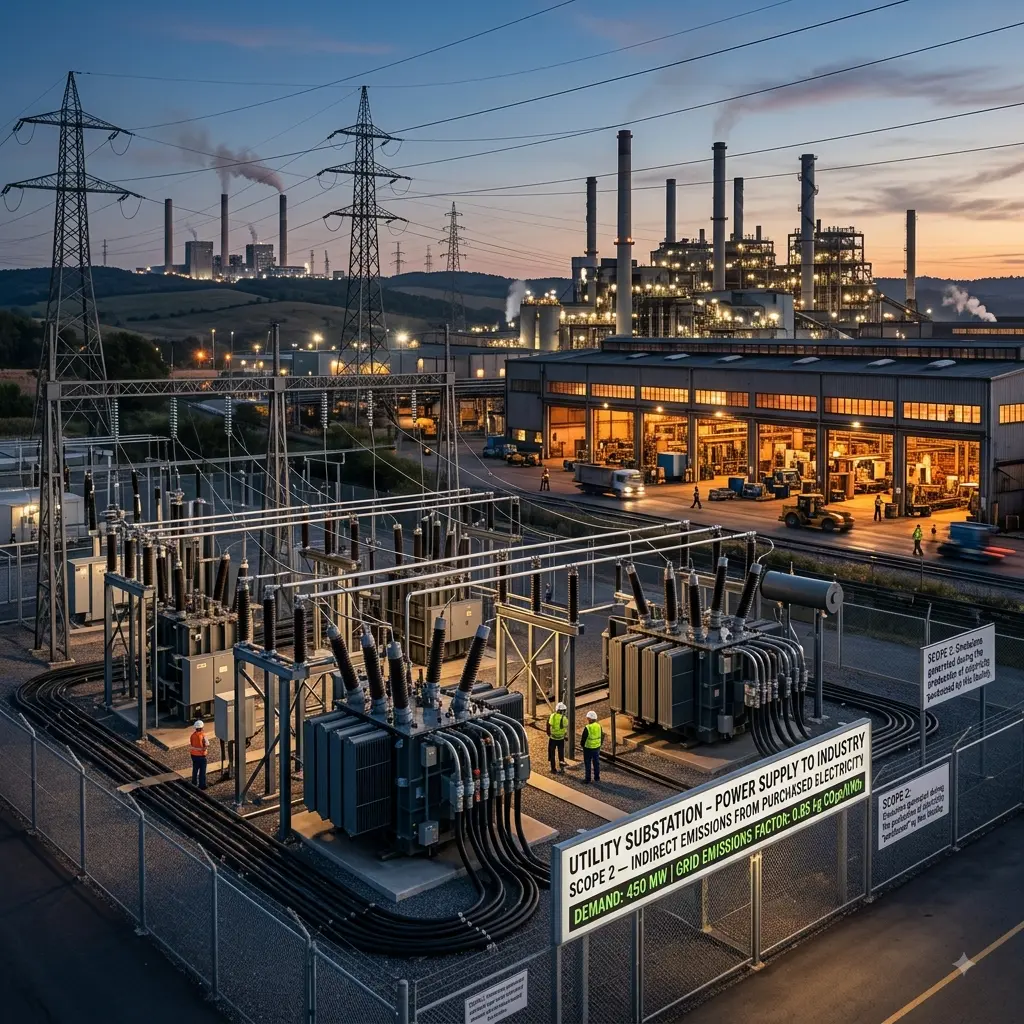
Scope 2 emissions cover the indirect greenhouse gas emissions created during the generation of electricity, steam, heating, or cooling that your factory purchases from external suppliers (such as your state electricity board or private discoms).
Even though the emissions physically happen at a thermal power plant miles away, CBAM requires you to account for the carbon intensity of the power used to run your machinery.
The Indian Context: Grid Factors and Renewable Opportunities
For Indian MSMEs, Scope 2 is often the largest single component of a product’s embedded emissions profile:
- The Indian Grid Emission Factor: India’s national power grid relies heavily on coal-fired thermal generation. As a result, the official Grid Emission Factor for India is relatively high compared to Western European grids. Every kilowatt-hour (kWh) of standard grid power consumed adds a measurable carbon load to your exported goods.
- Captive Renewable Power Advantage: If your plant utilizes rooftop solar, open-access wind energy, or captive hydro power, CBAM allows you to account for this zero/low-emission power—provided you have the necessary wheeling agreements and generation logs. This significantly reduces your product’s calculated carbon intensity, giving you a competitive edge over manufacturers relying purely on grid electricity.
What Data You Need to Collect
Gathering Scope 2 data is straightforward and relies on standard utility records:
- Monthly State Electricity Board (DISCOM) bills detailing total active power consumption in kWh.
- Sub-metering logs if your facility shares power between CBAM-covered export lines and non-CBAM domestic lines.
- Generation and consumption certificates for on-site solar or renewable power purchase agreements (PPAs).
Precursors — The Hidden Carbon in Your Raw Materials

If you manufacture “complex goods”—such as steel pipes, fasteners, bolts, or aluminum frames—your product’s carbon footprint is not generated entirely within your four walls. It begins with the raw materials you purchase from your upstream suppliers.
Under CBAM, these are known as precursors. If you buy semi-finished goods (like steel billets, ingots, or wire rods) to create your final export, the EU requires you to include the carbon footprint of those inputs in your final declaration.
Why Precursors Matter for Your Bottom Line
Think of your product’s total embedded emissions as a chain. If your upstream steel supplier operates a highly inefficient, coal-heavy blast furnace, that “carbon debt” is transferred to your product.
When you export your finished goods to the EU, your importer must declare the total footprint. If you cannot provide verified data for your raw material inputs, the EU will force your importer to use EU Default Values. These defaults are intentionally set to the “worst-case scenario” (often 30–80% higher than average actual emissions), which can make your products significantly more expensive than those of your competitors who track and report actual precursor data.
How to Handle Precursors: The Data Chain
You do not need to calculate the emissions for your suppliers from scratch. Instead, you need to establish a Data Chain of trust:
- Request Mill Test Certificates (MTCs) & Emission Statements: Ask your raw material vendors for a formal “CBAM Emission Statement.” This document should confirm the specific embedded emissions (in tonnes of $CO_2e$ per tonne of material) for the batch you purchased.
- The 80% Rule: Under current CBAM rules, you are expected to provide actual data for at least 80% of your complex goods’ precursor inputs. If you lack data for a minor component, you may use default values for the remaining percentage, but relying on defaults is a losing strategy for long-term price competitiveness.
- Supplier Engagement: If your supplier says they “don’t know” their carbon footprint, share the link to the European Commission’s official CBAM guidance. Their ability to provide this data is quickly becoming a prerequisite for doing business with EU-facing exporters.
Checklist: What to Collect from Suppliers
To ensure your reports are accurate, start requesting the following from your raw material vendors:
- Product Name & CN Code: To ensure it matches the CBAM Annex I list.
- Specific Embedded Emissions: The total $CO_2e$ per tonne of the material provided.
- Country of Origin: Required for selecting the correct default values if actual data is unavailable.
- Verification Status: Confirmation of whether the data has been audited by a third party (this adds significant credibility to your report).
Pro Tip: Don’t wait for your EU buyer to ask. Being the first in your supply chain to provide a verified “Carbon Passport” for your materials proves you are a reliable, future-proof partner—a major advantage when importers are looking to consolidate their supplier lists to avoid CBAM administrative headaches.
What You DON’T Need to Calculate (The Scope 3 Relief)
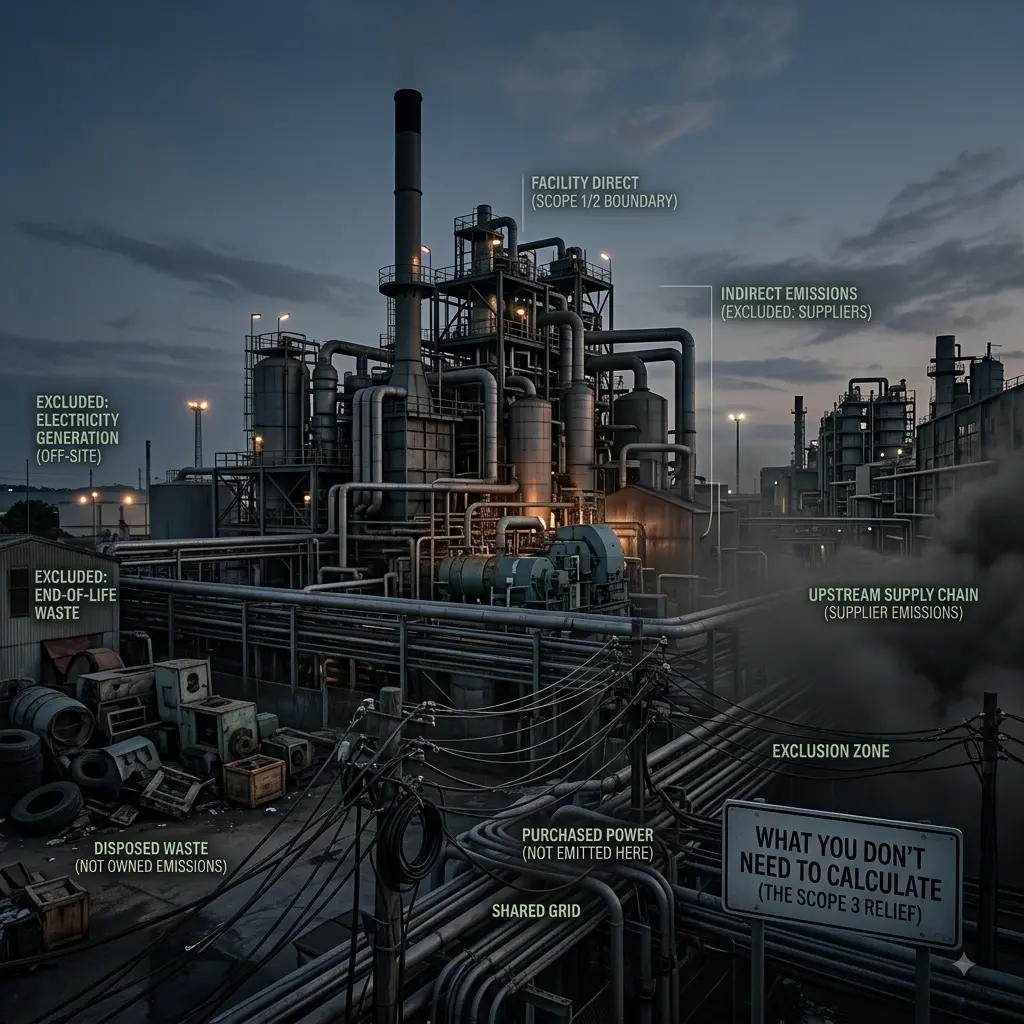
When sustainability consultants talk about “Scope 3 emissions,” they are referring to a massive, complex category that includes almost every indirect activity in your company’s entire value chain—from the fuel burned by the truck that delivers your goods to the port, to the electricity used by your employees at home.
For CBAM compliance, you can breathe a sigh of relief: most of this is irrelevant.
CBAM does not require you to conduct a full corporate carbon audit. It is strictly a product-level mechanism. The European Union only cares about the carbon physically “baked into” the product during the manufacturing process.
What You Can Safely Ignore
You do not need to track, calculate, or report the following categories for your CBAM declaration. Spending time on these is a distraction from your actual compliance requirements:
- Logistics & Transportation: Emissions from shipping your finished goods to the EU (or even from raw materials arriving at your gate) are excluded. The “system boundary” for CBAM generally stops at your factory exit gate.
- Employee Commuting & Business Travel: How your staff travels to work or your sales team flies to meet clients has zero impact on your CBAM report.
- Administrative Overheads: The electricity used in your head office, corporate HVAC systems, or factory lighting in non-production areas does not need to be allocated to your product’s carbon footprint.
- Capital Goods: Emissions from the production of your machinery, factory buildings, or office equipment (embodied carbon in infrastructure) are outside the scope of CBAM.
- Waste Disposal & End-of-Life: You are not responsible for the emissions generated when the consumer eventually recycles or disposes of your product.
Why the Distinction Matters
By filtering out these “noise” categories, you stop wasting thousands of rupees on unnecessary data collection. Your goal is to keep your reporting lean and audit-ready.
Focusing your resources exclusively on the Direct (Scope 1) and Energy-related (Scope 2) inputs within your production lines—plus the precursors (raw materials) that make up your finished good—will give you exactly what you need to satisfy EU customs authorities without the burden of a full-scale corporate ESG report.
The Rule of Thumb: If the activity didn’t physically contribute to the transformation of raw material into your finished export, leave it out of your CBAM calculations.
Plant Manager’s CBAM Data Checklist
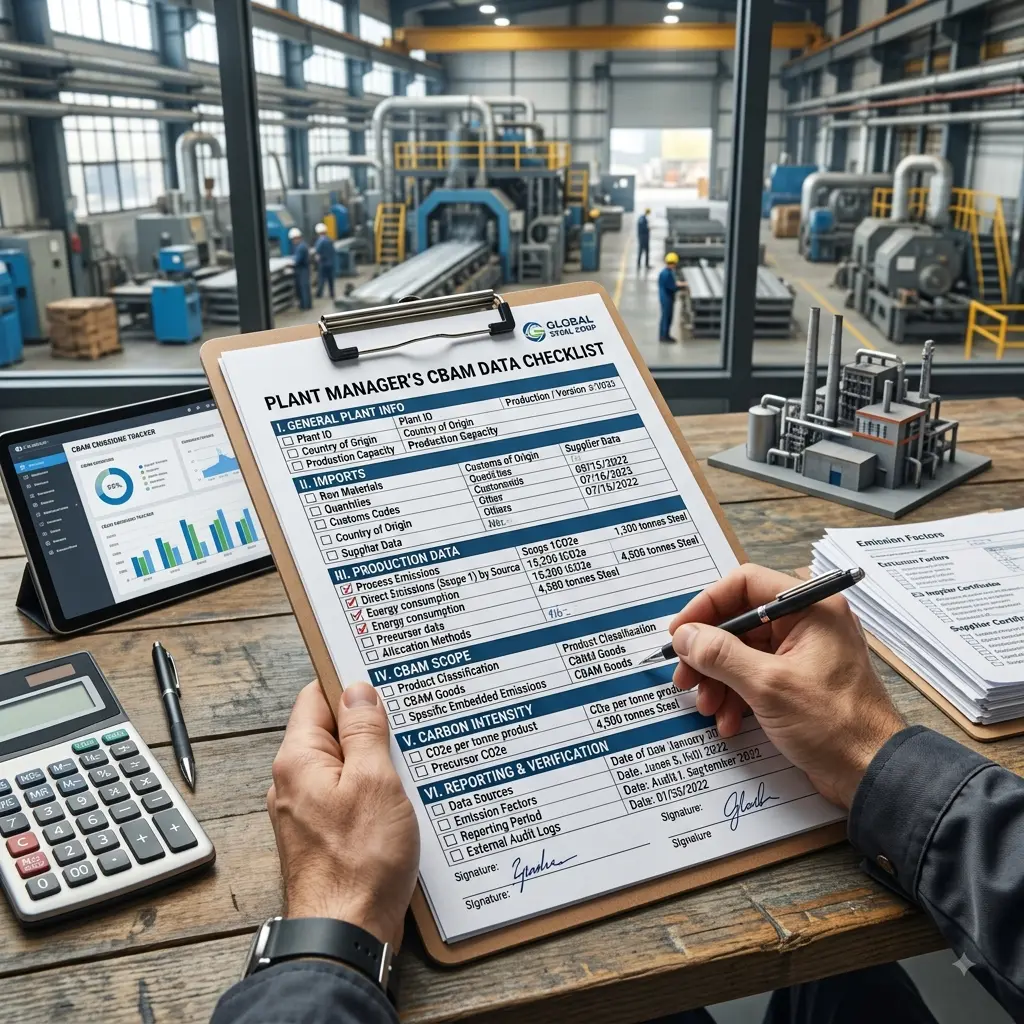
To prepare an audit-ready CBAM report, your plant operations team does not need complex environmental software. You simply need to gather specific operational records already available across your purchase, energy, and production departments.
Hand this checklist directly to your Plant Manager or Operations Head to begin compiling your data set:
1. Facility & Production Baseline
- [ ] Total Facility Output: Total metric tonnes ($t$) of all goods produced during the reporting period (both CBAM and non-CBAM goods).
- [ ] CBAM Production Volume: Net mass ($t$) of specific CBAM goods exported to the EU (matched to 8-digit CN/HS codes).
- [ ] Production Operating Hours: Active manufacturing hours logged for the relevant production lines.
2. Direct Energy & Fuel Consumption (Scope 1)
- [ ] Stationary Fuel Invoices & Meter Logs: Total consumption figures for:
- Furnace Oil / LDO / HSD (in litres)
- Natural Gas / PNG (in $m^3$ or $MMBTU$)
- LPG / Propane (in $kg$)
- Coal / Petcoke (in metric tonnes)
- [ ] DG Set Logbooks: Total diesel consumed (litres) specifically during backup power generation for production runs.
3. Indirect Electricity Data (Scope 2)
- [ ] Utility Electricity Bills (DISCOM): Monthly grid electricity consumption in kilowatt-hours ($kWh$).
- [ ] Sub-metering Records: $kWh$ logs if your facility shares power meters between export lines and domestic production lines.
- [ ] Captive / Open-Access Renewable Records: Monthly generation certificates, solar generation logs, or Power Purchase Agreements (PPAs) demonstrating non-grid renewable power usage.
4. Precursor & Raw Material Records
- [ ] Raw Material Invoices: Total mass ($t$) of purchased steel, aluminum, iron, or other input precursors.
- [ ] Supplier CBAM Statements / Mill Test Certificates (MTCs): Country of origin and verified specific embedded emissions (tCO2e/t) provided by your raw material vendors.
Ready to Convert Raw Data Into EU Compliance?
Gathering factory data is only step one. Formatting these numbers into official, accredited CBAM XML declarations requires specific emission factors and calculations. [Upload your data checklist to our automated CBAM portal] or [speak with our compliance team] to generate your audit-ready CBAM report today.
The 2026 Definitive Phase: Your New Financial Reality (See text below)

1. The Requirement for Third-Party Verification
Note: Under the 2026 rules, the data provided by the supplier (you) to the importer must be verified by an independent, EU-accredited third-party verifier. Without this verification, the importer cannot use your “actual” data and will be forced to use penalty-level default values.
2. The Legal Burden (Importer vs. Supplier)
The EU Importer is the “Authorised CBAM Declarant” legally responsible for the report. However, they cannot legally fulfill this without the Supplier Statement (the document you are helping the exporter create). Frame your service as “The engine that generates the Importer’s required proof.”
3. The “Actual” vs. “Default” Penalty Risk
Since 2026, default values are set at the “worst-performing” level (often 30–80% higher than average). Explicitly state: “Using default values is a direct tax on your export margins. Only ‘Actual Data’ reporting protects your competitive pricing.”
4. The 4-Year Record Keeping Rule
Note: “You are legally required to maintain all fuel logs, electricity bills, and verification statements for four years following the reporting year to survive retroactive EU customs audits.”
Compliance Warning: ⚠️ The 2026 Compliance Update: From Reporting to Auditing Since January 1, 2026, the EU CBAM is no longer just a data-gathering exercise. It is now a financial obligation.
Verification is Mandatory: EU importers now require your emissions data to be certified by an independent, accredited verifier.
Default Values = Financial Penalties: If you do not provide verified, actual emission data, the EU applies “Default Values” calculated at punitive, high-emission levels. This increases the carbon tax your buyer must pay, making your product more expensive than competitors who report accurately.
Keep Your Records: You are required to archive all source documents (invoices, meter logs, MTCs) for at least 4 years for potential EU audits.

Conclusion — Moving from Data to Compliance

Understanding the distinction between Scope 1, Scope 2, and precursor emissions is the single most important step in demystifying EU CBAM. You now know that you don’t need an enterprise-grade sustainability audit—you simply need to organize the operational data your team already records every month.
However, gathering the numbers is only half the battle. The EU’s reporting portal requires your data to be formatted into precise XML files, calculated using specific regional Emission Factors, and adjusted based on complex allocation rules.
Don’t Let Technical Formatting Jeopardize Your Exports
Manual errors in your carbon declaration can lead to rejected reports, requests for corrections from EU customs, and—most dangerously—the application of EU Default Values. Relying on these punitive default values artificially inflates your product’s carbon footprint, potentially pricing you out of the European market compared to more efficient global competitors.
Take Control of Your CBAM Strategy
Stop treating CBAM as a bureaucratic hurdle and start using it as a competitive advantage. By accurately reporting your actual emissions, you prove your manufacturing efficiency and secure your position as a trusted partner for European buyers.
Ready to turn your factory logs into an audit-ready CBAM declaration?
- For MSME Owners: [Schedule a 15-Minute Compliance Audit] with our specialists to review your data readiness.
- For Operations Managers: [Upload Your Data Checklist] to our automated portal and get your first CBAM report generated in hours, not weeks.
- Need Clarity? [Download our Free CBAM Documentation Guide] to see exactly how to request emission statements from your raw material suppliers.
In 60 minutes, we will review your export profile, assess your CBAM exposure, and recommend the right compliance strategy.

One Comment