The Indian MSME Guide to EU CBAM: How to Keep Exporting in the Green Era

For decades, the journey of an Indian MSME exporter was defined by a familiar, hard-won blueprint: master your product quality, trim your operational costs, find a reliable European buyer, and navigate your containers safely through ports like Mundra or JNPT. If you could deliver precision-engineered steel fasteners, cast iron components, or high-grade aluminum profiles at a competitive price, your place in the lucrative European Union market was secure.
But the rules of global trade have fundamentally changed.
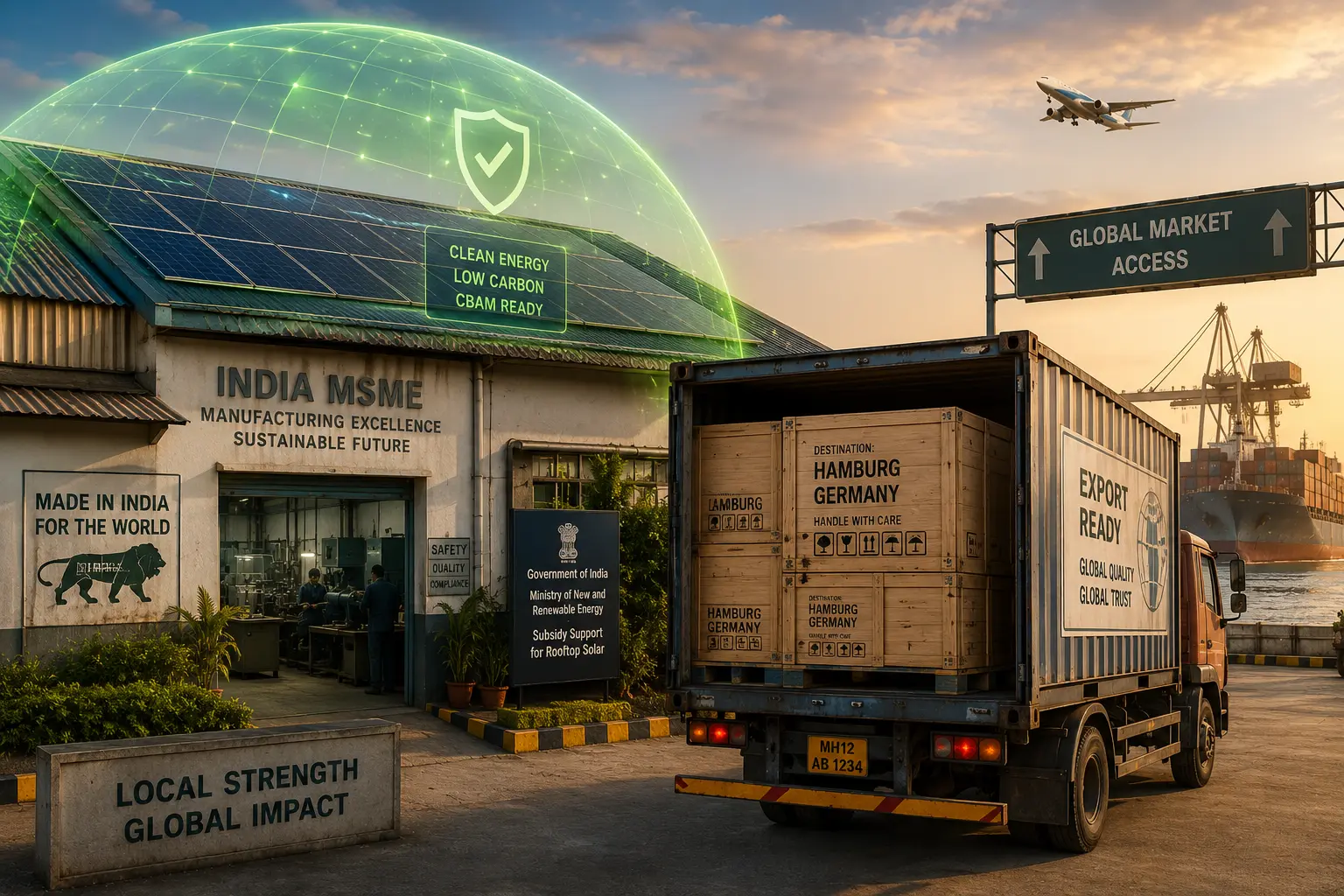
Today, shipping your goods to Europe is no longer just about quality, price, and logistics—it is now strictly about your carbon footprint. In this new era of international commerce, a high environmental footprint is treated exactly like a manufacturing defect, and it comes with a steep financial penalty.
The biggest wake-up call for Indian exporters is that the clock has run out on preparation. The EU’s Carbon Border Adjustment Mechanism (CBAM) has officially transitioned out of its “transitional” trial phase and entered its rigorous definitive phase. The days of simply filling out basic quarterly paperwork are over. Entering this permanent phase means facing real, severe financial penalties for non-compliance, mandatory third-party audits, and actual financial obligations to buy carbon certificates for your embedded emissions.
For India’s Micro, Small, and Medium Enterprises (MSMEs), this isn’t a distant policy debate happening in Brussels. It is an immediate threat to your bottom line. Rumors of compliance setups and third-party validation costing anywhere from ₹15 to ₹20 Lakhs per manufacturing unit have sent waves of anxiety through industrial clusters from Ludhiana’s steel hubs to Coimbatore’s engineering foundries. For a small business, these figures look like a wall blocking the gateway to Europe.
However, beneath the heavy bureaucracy lies a massive silver lining.
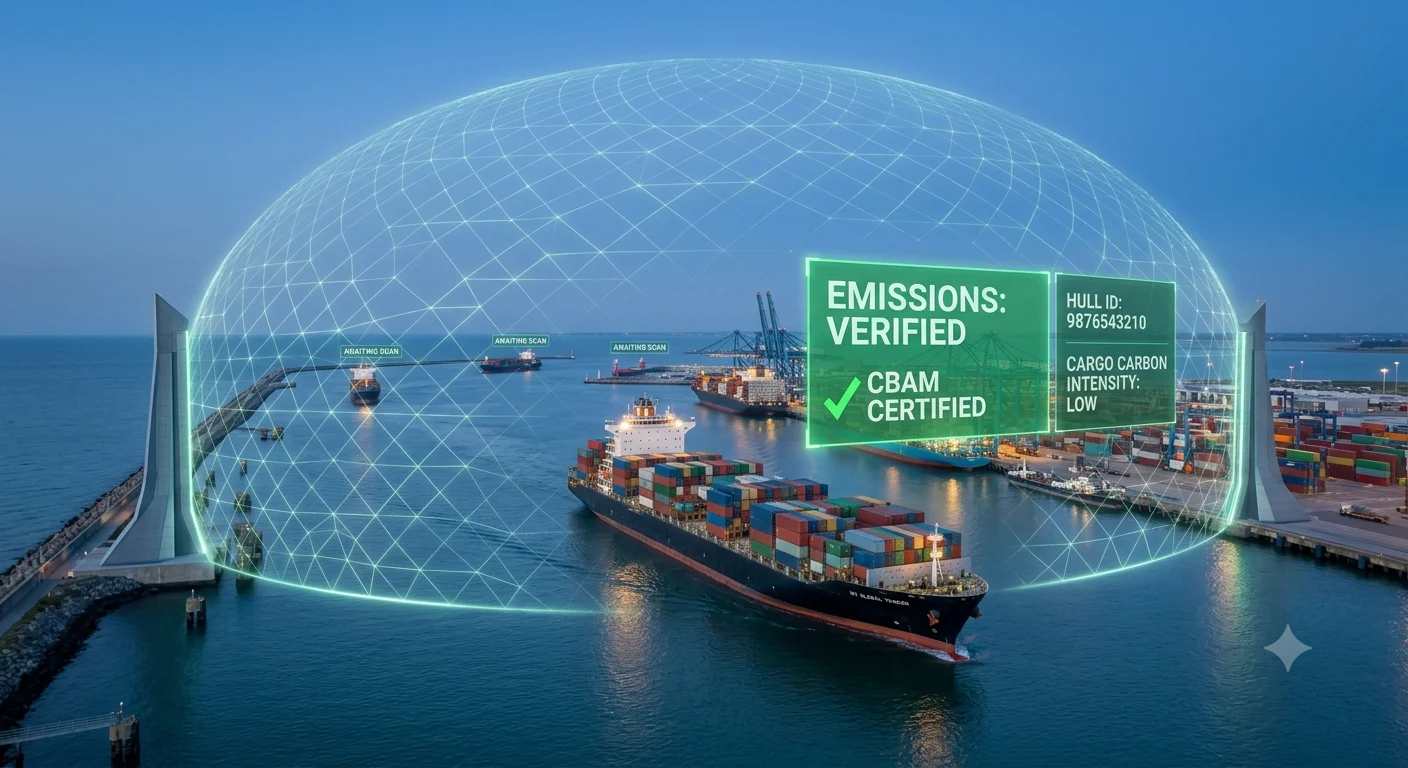
First, the Indian government has stepped up to cushion the blow, introducing robust support schemes that can subsidize up to 90% of these compliance and auditing fees for eligible small businesses. Second, this is a massive opportunity to outpace your global competition. European buyers are actively looking for “green” suppliers to protect themselves from heavy EU taxes. By tackling CBAM early, investing in cleaner production, and mastering your data collection, your small factory can transform a daunting regulatory hurdle into a premium, long-term competitive advantage.
This guide cuts through the dense legal jargon to give you a plain-English, actionable roadmap to protect your exports and keep your goods flowing into Europe without friction.
CBAM Demystified: What is it, exactly?

If you read the official European Union documents, the Carbon Border Adjustment Mechanism (CBAM) is described as a “landmark tool to put a fair price on the carbon emitted during the production of carbon-intensive goods entering the EU.”
Let’s strip away the diplomatic language and look at what it actually means for your business.
A Simple Definition of CBAM
At its core, CBAM is an environmental border check. It is a mechanism that charges a carbon fee on specific imported goods entering the EU. The goal is to make sure that foreign products face the exact same environmental costs as goods manufactured by European domestic factories.
Historically, if a steel mill in Germany produced a tonne of steel, it had to pay a heavy price for the carbon dioxide it pumped into the air. If a factory in India produced that same steel without a carbon penalty, the Indian steel could be sold in Europe much cheaper. CBAM is designed to eliminate that price difference by charging the foreign goods at the border.
The “Why”: Stopping Carbon Leakage
To understand why the EU is doing this, you need to understand a concept called carbon leakage.
Over the years, the EU has made its domestic environmental laws incredibly strict. This created an unintended problem: instead of cleaning up their act, some European companies simply closed their factories in Europe and moved their manufacturing to countries with relaxed environmental laws. They would manufacture the goods cheaply abroad and then ship them right back into Europe.
This behavior didn’t help the planet—it just shifted the pollution somewhere else, while destroying European manufacturing jobs. CBAM acts as a regulatory wall to stop this. By taxing the carbon footprint of imports, the EU ensures that companies cannot bypass climate laws by moving their factories overseas.
Is it a Tax? (The Legal Loophole)
When you hear about CBAM in the news, it is almost always referred to as a “carbon tax.” However, legally and technically, it is not a direct border customs tax.
Calling it a tax would violate World Trade Organization (WTO) rules and trigger massive international trade wars. Instead, the EU designed CBAM as a certificate-purchasing system.
Here is how it works under the hood:
- Your European importer must register as an “authorized CBAM declarant.”
- Every year, they must calculate the total “embedded emissions” of the goods they bought from you.
- They must then buy a corresponding number of CBAM certificates to cover those emissions.
The price of these certificates is not fixed. It is directly tied to the weekly average auction price of the EU Emissions Trading System (ETS)—the domestic market where European factories buy and sell pollution permits. If the price of carbon goes up in Europe, the price of your CBAM certificates goes up at the border.
As an Indian exporter, you won’t be paying this fee directly to the EU authorities; your European buyer will. However, if your factory has high emissions, your buyer will have to buy more certificates, making your goods far more expensive to land in Europe than a cleaner competitor’s.
Does This Apply to Me? (The Product Checklist)
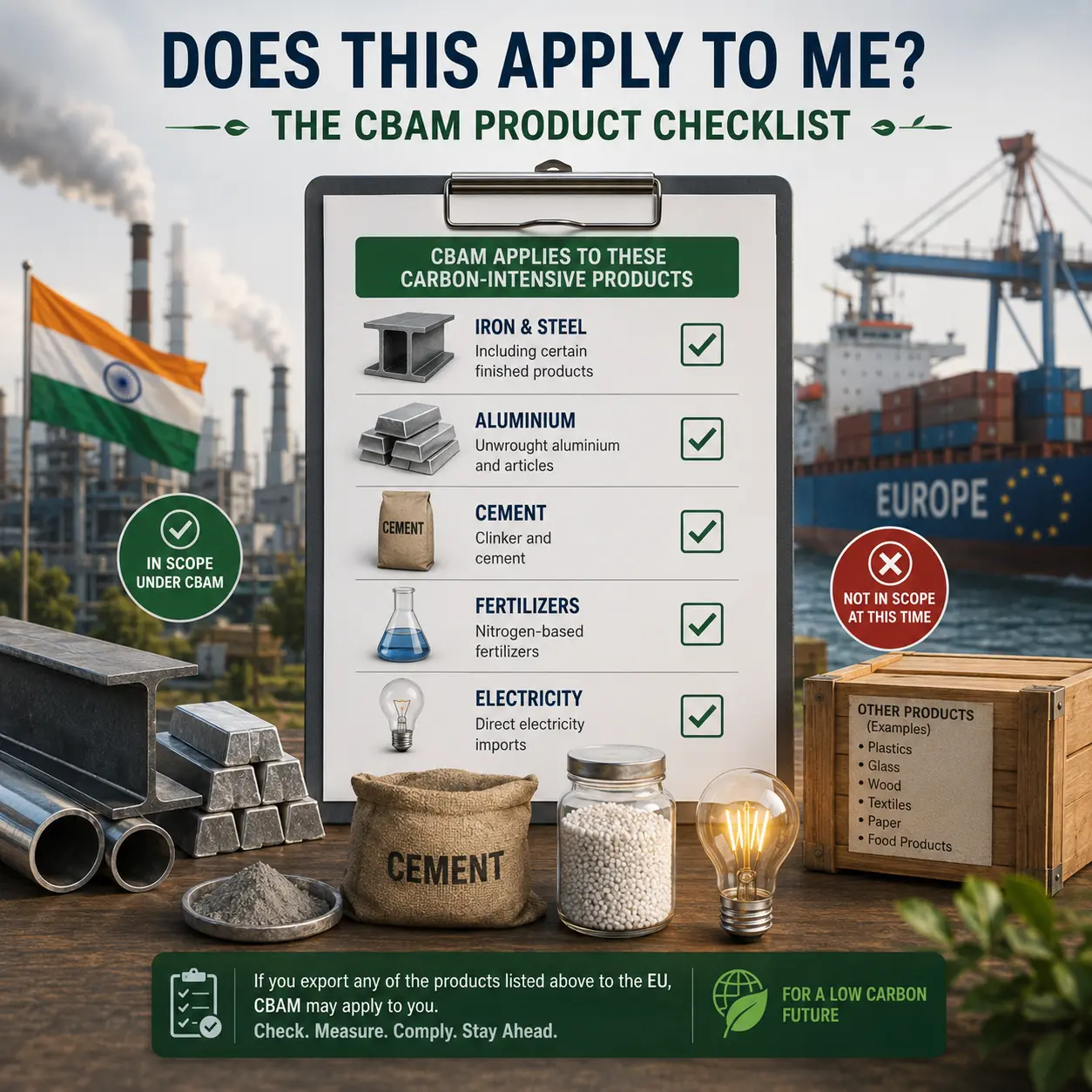
Before you dive into complex carbon accounting or call an external consultant, you need to answer the most fundamental question: Does my product actually fall under the CBAM umbrella?
The EU is rolling out this regulation in waves. Right now, it target sectors that are highly “carbon-intensive”—meaning their manufacturing processes naturally release massive amounts of carbon dioxide.
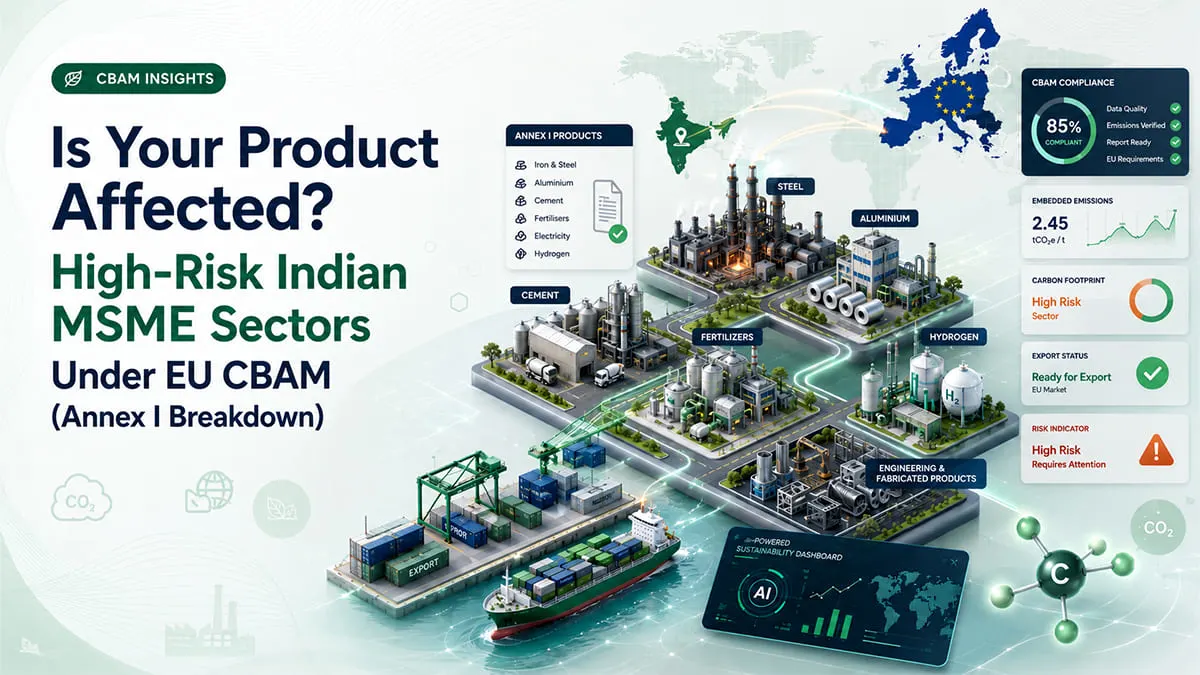
The “Big 6” Sectors Affected by CBAM
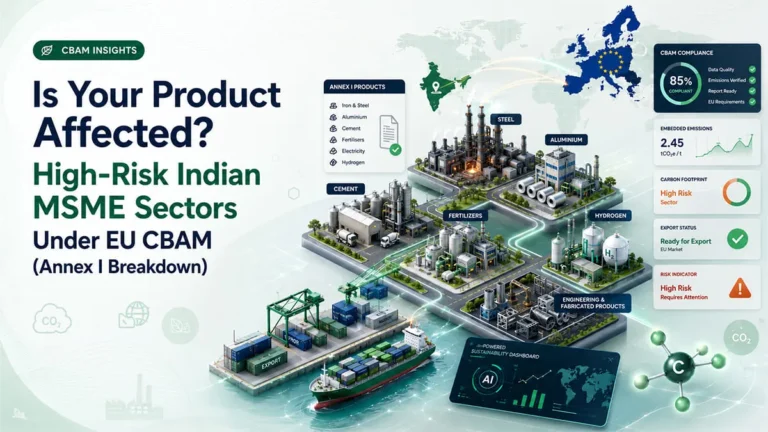
If your primary manufacturing business belongs to or supplies components for one of these six sectors, you are directly in the line of fire:
- Iron & Steel: This is the biggest category hitting Indian MSMEs. It doesn’t just cover raw steel blocks or sheets; it explicitly includes downstream fabricated items like bolts, screws, nuts, washers, and fasteners.
- Aluminium: Similar to steel, this covers raw aluminum as well as finished products like aluminum structures, tubes, pipes, and household aluminum hardware.
- Cement: Raw cement, clinker, and various types of binding cement used in construction.
- Fertilisers: Pure chemical fertilizers as well as ammonia and nitric acid mixtures.
- Hydrogen: Production of clean or industrial hydrogen gases.
- Electricity: Electrical energy imported directly via power grids (less relevant for physical goods exporters, but a major pillar of the law).
A Note for Fabricators: Even if you do not consider yourself a “steel company,” if you buy steel wire to manufacture small industrial screws and ship them to Germany, you are legally considered an exporter of an Iron & Steel product.
The HS Code Reality Check
Do not rely on broad descriptions or guesswork. The absolute definitive test for whether your product is included under CBAM is its Harmonized System (HS) Code—the standard international 6-to-8 digit customs commodity code you use on your export invoices.
The European Union has published a highly specific list of affected HS codes in Annex I of the EU CBAM Regulation.
For example, raw iron falls under Chapter 72, but downstream articles of iron and steel fall under Chapter 73. If your specific product’s HS code is listed in that annex, your EU buyer is legally required to report your emissions. It is highly recommended that you take your current export invoice, pull your HS codes, and cross-reference them directly against the official EU list or ask your customs broker to verify them.
The 50-Tonne Exemption: A Lifeline for Micro-Exporters
For many small and micro-enterprises, the cost of compliance could easily wipe out their entire profit margin. Recognizing this, the EU built a specific de minimis exemption into the law that acts as a critical loophole for smaller businesses.
If the total weight of your CBAM-governed goods shipped to a single EU importer stays under 50 tonnes per year, the shipment is entirely exempt from CBAM financial obligations and reporting.
| Shipment Category | Annual Weight Threshold | CBAM Status |
| Micro-Consignments | Less than 50 Tonnes total per importer | Exempt (No certificates required) |
| Commercial Shipments | 50 Tonnes or greater per importer | Full Compliance Required |
Let’s look at how this plays out in practice:
- Scenario A: You are a small artisanal foundry in Punjab exporting 35 tonnes of specialized steel brackets annually to a single buyer in France. Because the total weight is under 50 tonnes, your buyer does not have to worry about CBAM certificates for your goods.
- Scenario B: You export 25 tonnes of fasteners to a buyer in Germany, and 30 tonnes to a buyer in Italy. Even though your total exports are 55 tonnes, neither individual importer crossed the 50-tonne threshold. You remain clear of the regulations.
- Scenario C: You send 52 tonnes to a single German warehouse. You cross the line, and the entire 52 tonnes must be fully accounted for.
If you are a very small exporter operating near this threshold, it may make strategic business sense to cap your seasonal volumes or split your client base to naturally stay under the 50-tonne mark and completely avoid the bureaucratic headache.
The “Default Value” Trap: Why Ignorance is Expensive
Mark-Up Penalty: An Escalating Toll
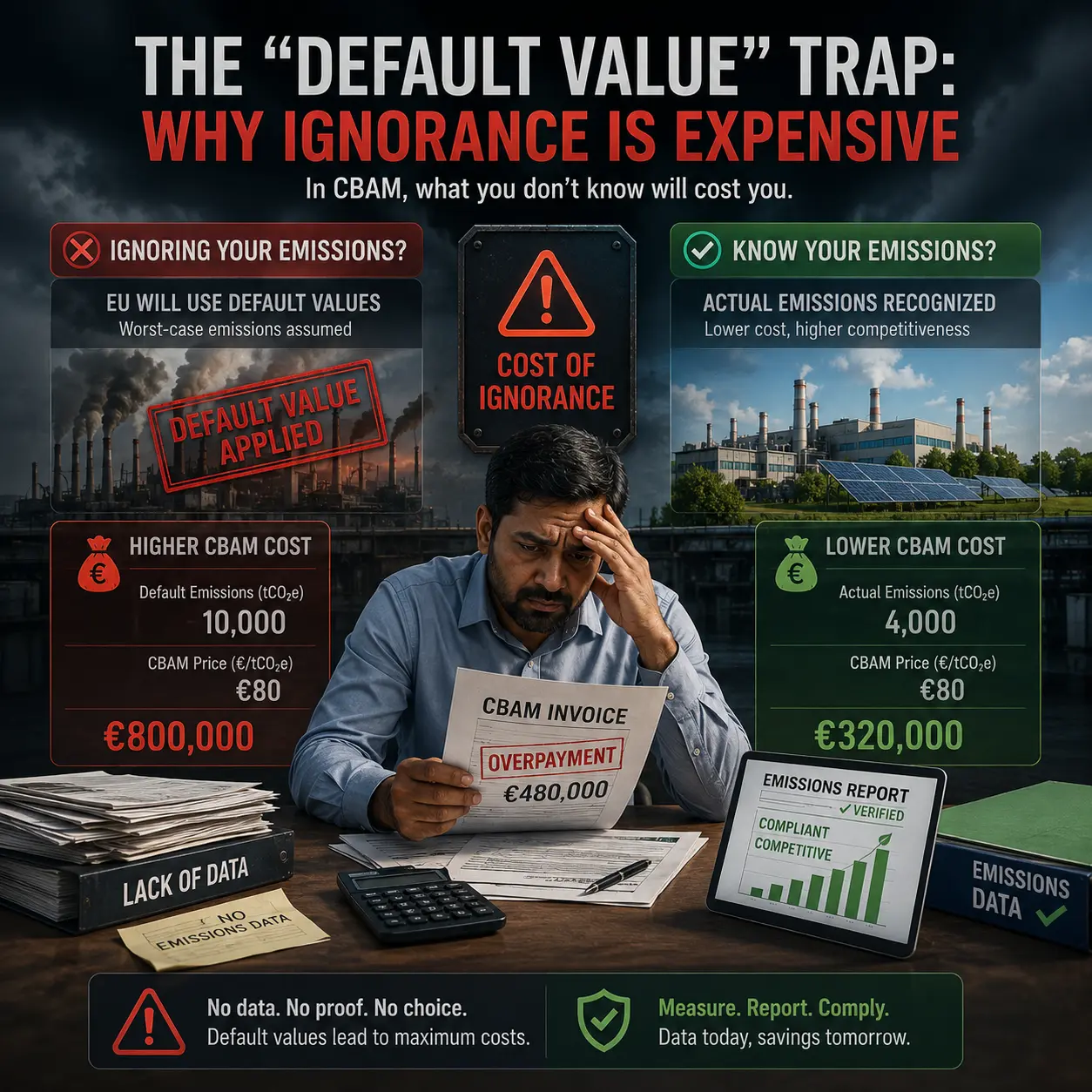
To ensure that nobody relies on default values as an easy way out, the EU has introduced an escalating “top-up” or mark-up penalty on these baseline figures. If you default, your calculated emission liabilities are automatically inflated by a blanket percentage that rises drastically year-over-year:
- 2026: A baseline 10% mark-up is added to the already inflated default values.
- 2027: The penalty climbs to a 20% mark-up.
- 2028 and beyond: The penalty peaks at a staggering 30% mark-up.
(Note: The fertilizer sector is the sole exception, scaling at a more gradual 1% annually due to agricultural price sensitivities).
Every extra percentage point added to your default value translates directly into more CBAM certificates your European buyer has to buy. If the market price for carbon in Europe spikes, this compounding penalty acts as a multiplier, turning a minor oversight into a massive, back-breaking invoice.

The Business Impact: Getting Priced Out of Europe
Ultimately, your European buyers will look at your relationship through a strictly financial lens: What is the total landing cost of your goods?
If you rely on default values, your product automatically becomes artificially expensive at the EU border. Consider your competition. Countries like Turkey or Egypt sit much closer to the EU, possess tightly integrated supply chains, and have been aggressively setting up local verifiers to provide actual, low-emission data.
If a German importer can buy steel bolts from a Turkish supplier who provides accurate, verified data showing low carbon intensity, or from an Indian MSME whose goods carry a punitive country-default value plus a 10% to 30% penalty, the choice is simple. They will switch suppliers to protect their own balance sheet. In short, failing to measure your carbon output doesn’t just cost money—it actively hands your market share to global competitors who did their homework.
Step-by-Step Compliance Checklist for Indian MSMEs
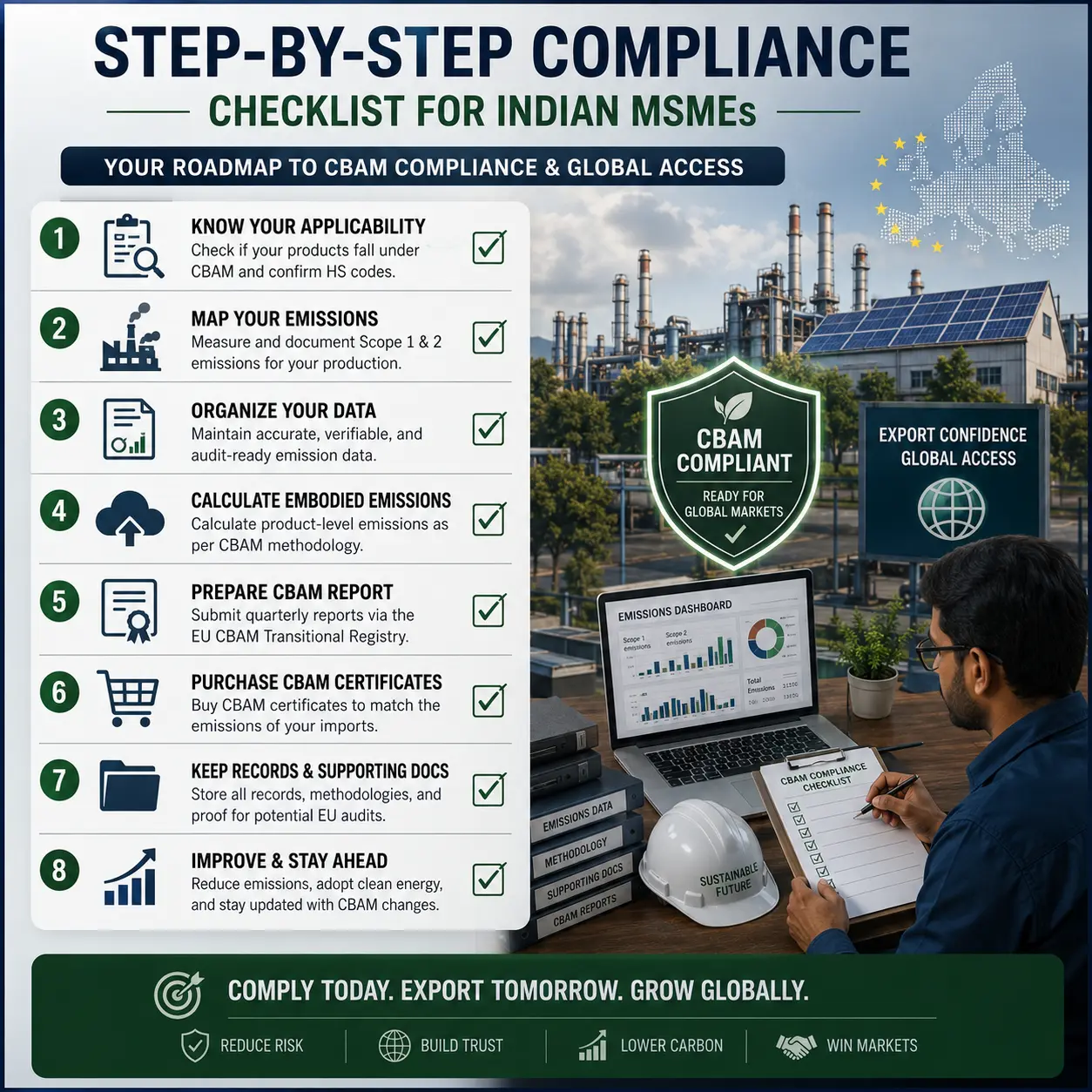
Ad-hoc ledger entries and guesswork will no longer cut it in the definitive phase. To protect your European supply contracts, your manufacturing facility must transition to a highly structured, legally binding process known as MRV (Monitoring, Reporting, and Verification).
To help your small business stay compliant without getting lost in the paperwork, execute this step-by-step checklist.
The 4-Step CBAM Onboarding Process
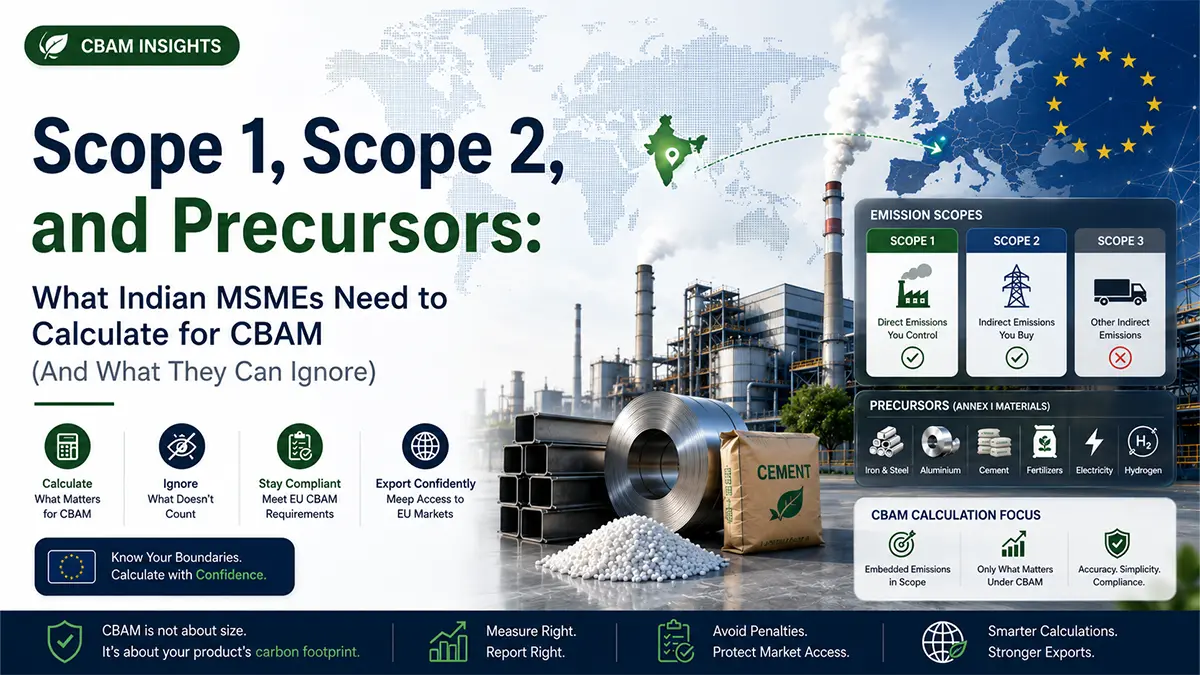
Step 1: Categorize and Map Your Emissions (Scope 1 vs. Scope 2)
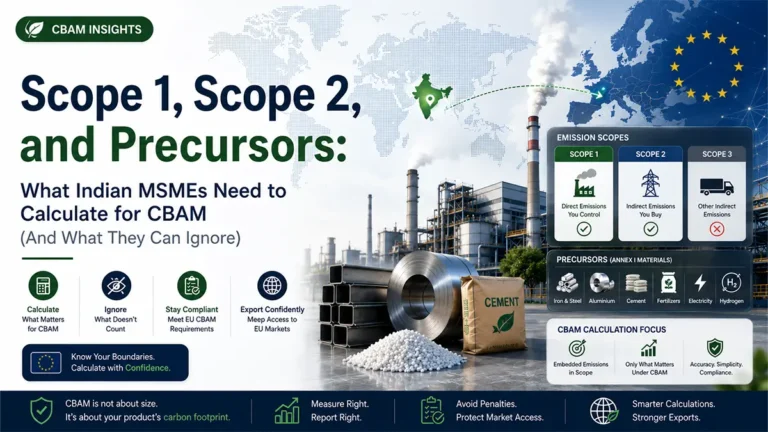
Before you can count your carbon, you must categorize it according to EU rules. The EU evaluates emissions per metric tonne of product based on two distinct streams:
- Scope 1 (Direct Emissions): This covers any greenhouse gas released directly inside your factory walls. If you burn coal, diesel, or natural gas in your furnaces, boilers, or kilns to melt steel or mold aluminum, that is a Scope 1 emission. It also includes chemical process emissions, like reactions that release gas during smelting.
- Scope 2 (Indirect Emissions): This covers the carbon footprint of the energy you buy from the grid. Even if your factory doesn’t burn fossil fuels on-site, the electricity you draw from the state grid (like state electricity boards) has an embedded carbon cost based on how those power grids generate electricity.
Crucial Precursor Rule: If you manufacture downstream goods like steel screws, you are also responsible for tracking the “precursor” emissions—meaning you must ask your upstream suppliers how much carbon was emitted just to make the raw steel wire they sold to you.
Step 2: Establish an English-Language Monitoring Plan
You cannot simply send an excel sheet to Europe. Under Article 14 of the CBAM regulation, your factory must establish a formal, written Monitoring Plan drafted in English.
This document serves as your facility’s carbon rulebook. It must clearly define your installation’s boundaries, specify exactly where meters are placed on your production lines, outline how often you measure fuel and power usage, and document the specific production technologies you use (e.g., Electric Arc Furnace vs. Blast Furnace). This plan proves to EU regulators that your data collection is consistent, accurate, and completely transparent.
Step 3: Register Globally on the EU O3CI Portal
The European Commission launched a dedicated IT system called the O3CI Portal (Operators of Third-Country Installations). This platform completely changes how data is shared.
Instead of emailing sensitive commercial data and carbon spreadsheets to five different European buyers, you register your Indian factory directly on the O3CI registry via an authenticated EU Login. Once registered, you upload your installation’s verified carbon data to this central database.
When your European buyers prepare their annual CBAM declarations, you simply use the portal to securely link your verified emissions data to their specific EORI number (their EU customs identification code). This populates their reports automatically, protecting your trade secrets and saving endless administrative hours.
Step 4: Schedule an EU-Accredited Third-Party Audit
Self-reporting is officially dead. The EU will not accept data calculated by your internal teams unless it has been formally validated by an independent, third-party auditing body.
Your annual emissions data must undergo a rigorous physical and digital audit conducted by an agency accredited under international standard ISO 14065 (or specific EU EN standards). In India, global verifiers like TÜV India, Bureau Veritas, SGS, and DNV review your primary billing evidence, check your fuel invoices, test your factory meters, and issue a formal Verification Statement. Without this accredited stamp of approval, your data is legally void, and your buyer will be forced to use the expensive “Default Value” penalty rate.
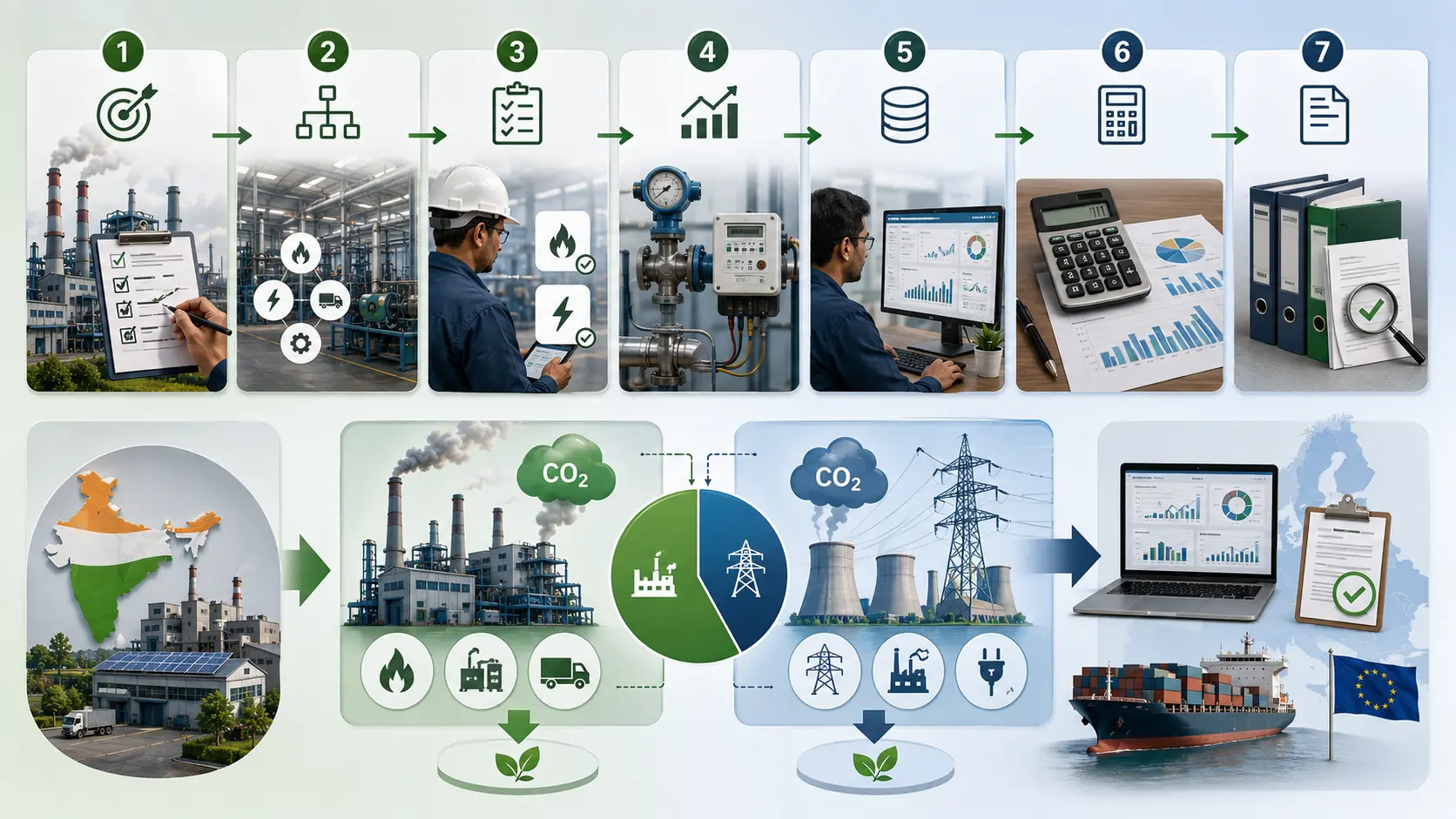
1.Map Emission Scopes: Week 1-2.
Identify all direct fuel burning (Scope 1) and purchased electricity inputs (Scope 2) on your shop floor.
2.Draft Monitoring Plan: Week 3-5.
Codify your measurement intervals and data boundaries into a formal English-language methodology document.
3.Upload to O3CI Portal: Week 6-8.
Create an EU login, register your facility, and log your baseline installation data into the official EU database.
4.Execute Third-Party Audit:Annual Requirement.
Contract an ISO 14065 accredited auditor to physically verify your data and generate an official Verification Statement.
EU CBAM Implementation Guide
Technical Blueprint & Calculations for Indian MSME Shop Floors. “Click here to download the guide”
Financial Relief: The Indian Government’s 90% Safety Net
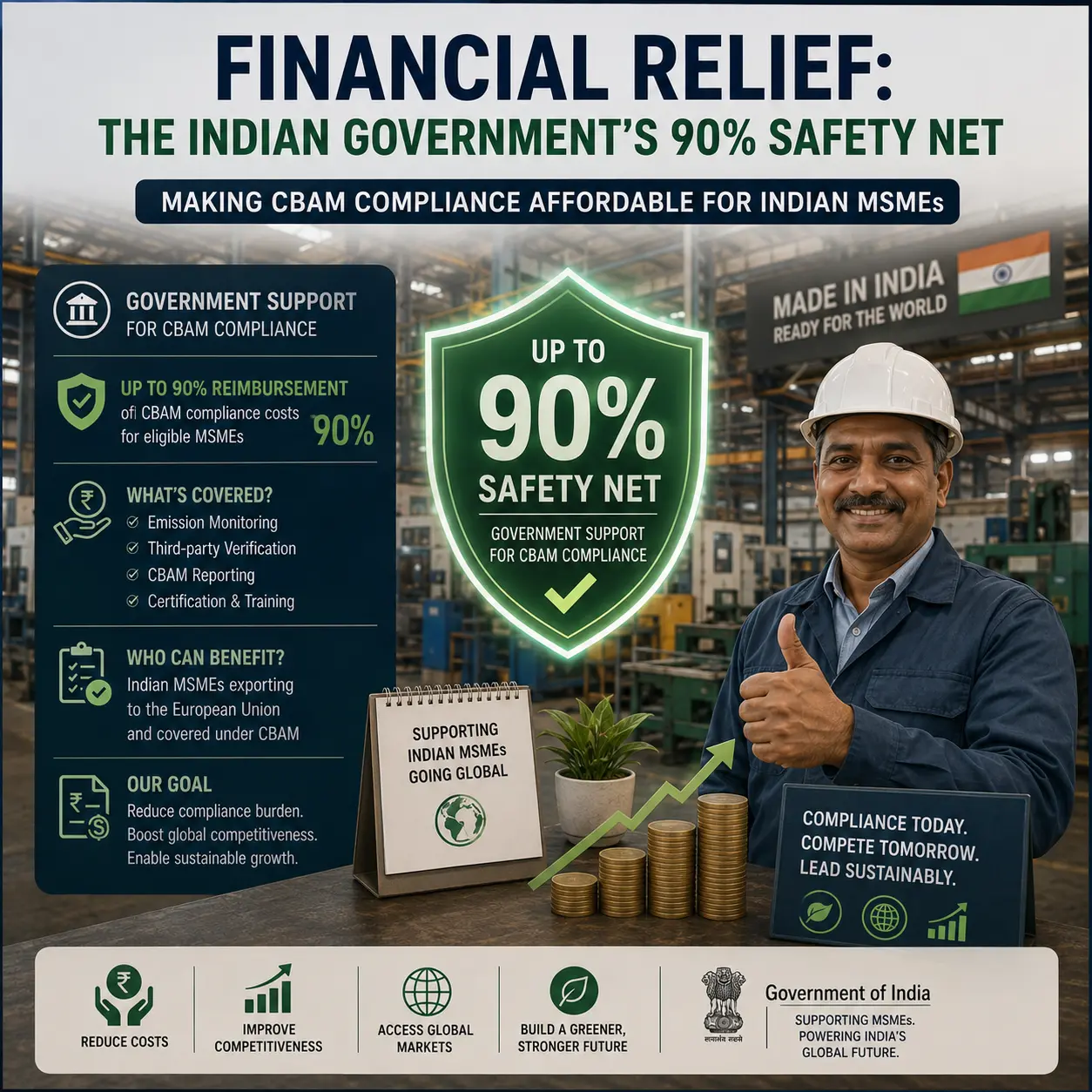
The administrative and financial weight of CBAM can feel incredibly crushing for a small business. When fixed compliance setups cost upwards of ₹15 to ₹20 Lakhs per factory, smaller operations face a disproportionate financial burden compared to multi-billion-dollar conglomerates.
Recognizing that these high fixed costs could make European trade commercially unviable for smaller units, the Government of India has stepped in with a robust financial buffer designed to protect the country’s export competitiveness.
The 90% Compliance Subsidy
To soften the blow, the Ministry of Micro, Small, and Medium Enterprises (MSME) is rolling out a targeted financial support scheme designed to absorb up to 90% of the total CBAM compliance bill for eligible micro and small businesses.
Rather than forcing small factories to dig deep into their working capital, this government-backed fund is structured to subsidize the heavy initial costs required to get your facility up to European standards.
| Compliance Component | Standard Market Cost | Government Subsidy Cover | Out-of-Pocket Cost for MSME |
| Carbon Accounting Systems, Digital Infrastructure & Accredited ISO 14065 Auditing Fees | ₹1,500,000 – ₹2,000,000 | Up to 90% Reimbursement | ₹150,000 – ₹200,000 |
By transforming a ₹20 Lakh roadblock into a manageable ₹2 Lakh operational expense, this safety net ensures that even local foundries and small-scale component fabricators can afford to keep their gateway to the EU open.
The Domestic Carbon Price Offset
One of the most critical legal levers built into the EU CBAM framework is the prevention of double taxation. Under Article 9 of the EU regulation, if an exporter has already paid a formal price for the carbon embedded in their goods within their home country, that exact amount must be fully deducted from the final CBAM bill at the European border.
India is aggressively capitalizing on this clause through the development of its own Carbon Credit Trading Scheme (CCTS).
How it saves you money: By setting up a domestic carbon market, the Indian government ensures that any carbon fees or clean-energy compliance costs you pay locally remain within the Indian economic ecosystem—used to fund domestic green infrastructure—rather than flowing directly into the treasury of the European Commission.
When your European buyer goes to declare your shipments, they will present the audited proof of your domestic carbon payments, cleanly wiping out or significantly lowering the number of expensive EU certificates they are forced to buy.
Strategic Reorientation: Looking Beyond the EU
While the government provides financial and legal armor to help you fight for your European market share, trade experts also advise a parallel survival strategy: market diversification.
The compliance challenges introduced by the EU (and the upcoming UK version of CBAM scheduled for 2027) mean that relying entirely on European buyers carries structural risks. The government, alongside national chambers of commerce like the PHDCCI, is actively supporting MSMEs in reorienting a portion of their export capacity toward regions with rapidly expanding infrastructure demands and less restrictive environmental barriers, such as West Asia, Latin America, and Africa.
Diversifying your client base doesn’t mean giving up on Europe; it means building an alternative trade pipeline so that your factory floors keep humming, no matter how fast international climate laws shift.
Conclusion: From Regulatory Hurdle to Competitive Edge
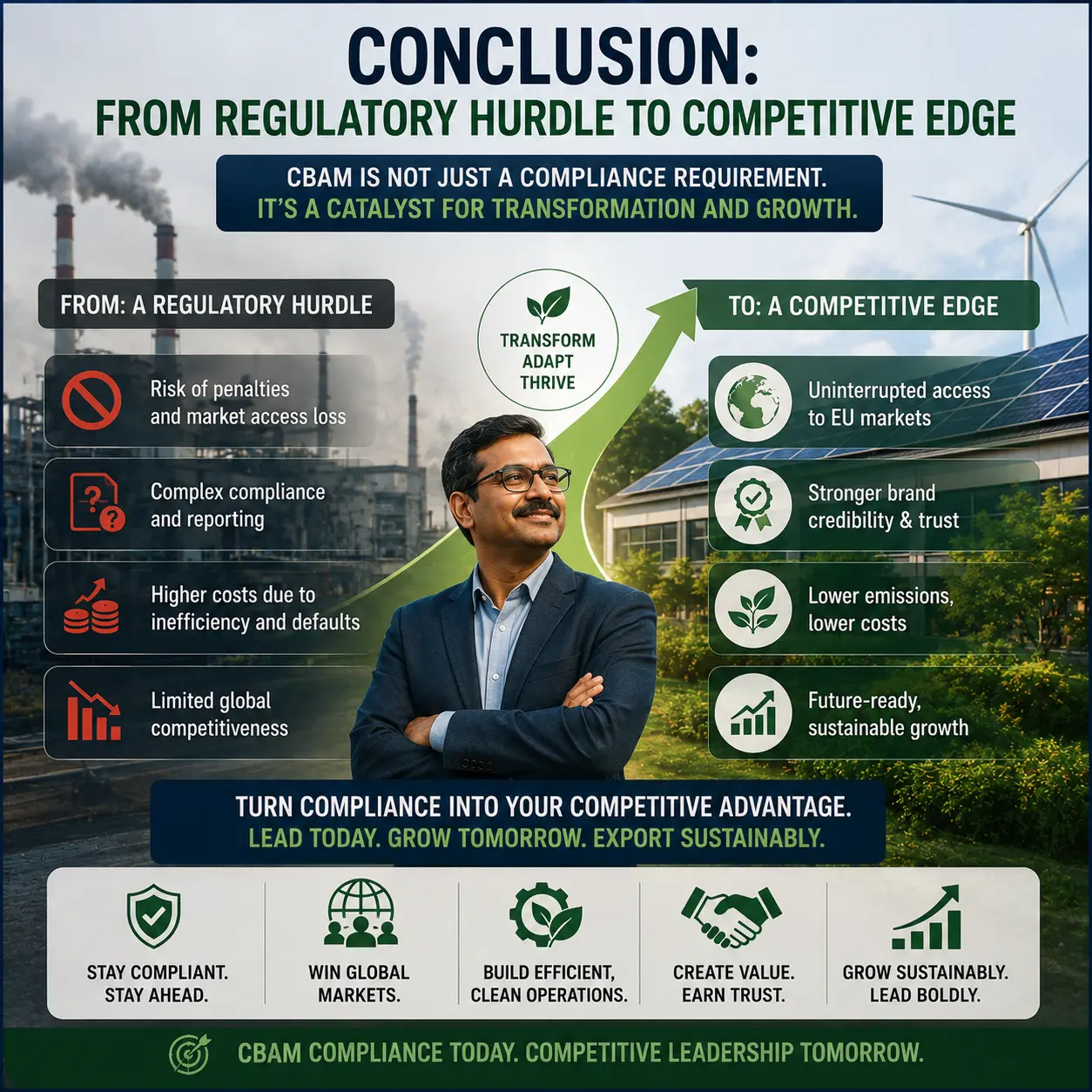
The arrival of the EU’s definitive CBAM phase marks an undeniable end to business-as-usual for global trade. For the unprepared, this framework functions as a steep trade barrier, raising production costs by 5% to 8% and imposing painful financial penalties at the European border. However, viewing CBAM strictly as a bureaucratic tax means missing the structural shift happening in the global economy.
The Green Premium: Compliance as a Marketing Tool
In the modern international market, carbon efficiency is the new currency. European buyers are actively hunting for suppliers who can keep their own domestic environmental liabilities low. If your small business can hand an EU importer an authenticated, low-emission dataset, you are not just passing a customs check—you are delivering a massive financial cost-saving directly to their balance sheet.
By achieving compliance early, Indian MSMEs unlock a powerful “Green Premium.” Certified low-carbon facilities are rapidly transforming from easily replaceable suppliers into indispensable, long-term strategic partners. When competing against factories that choose to stay in the dark, your verified carbon transparency becomes your ultimate marketing edge to secure premium, multi-year contracts across Europe.
Final Call to Action: Audit Today, Secure Tomorrow
The single biggest mistake an exporter can make right now is waiting. Waiting for a major European buyer to threaten to drop your contract, or waiting for country-level default penalties to eat into your margins, is a fast track to losing your hard-earned market share.
Do not let the complexity of carbon accounting stall your progress. Take the initiative today:
- Map your inventory: Pull your HS codes and trace your energy and fuel inputs on the shop floor.
- Leverage the safety nets: Access the Ministry of MSME subsidies to offset up to 90% of your auditing expenses.
- Build the infrastructure: Get an accredited third-party baseline audit on your books.
The green transition is no longer optional. By taking control of your facility’s carbon data today, you ensure that your factory stays running, your containers keep moving, and your small business thrives in the sustainable trade era.
For a deeper dive into the ground realities facing small businesses under this framework, the mint podcast on EU CBAM 2026 features industry experts breaking down the mandatory reporting rules, specific export business risks, and actionable compliance steps for Indian and Asian exporters navigating the definitive regime.
In 60 minutes, we will review your export profile, assess your CBAM exposure, and recommend the right compliance strategy.