
CBAM Factory Data Collection: Step-by-Step Playbook for Indian Plants (2026)

How to Collect CBAM-Ready Data from Your Factory Floor: A Step-by-Step Playbook for Indian Plant Managers

Stopping the Shop-Floor Panic
When European Union buyers demand “CBAM-compliant emissions records,” the reaction inside an Indian manufacturing plant is almost always immediate panic.
Plant managers and managing directors envision having to install expensive continuous emissions monitoring hardware, recruit specialized environmental engineers, or stop production lines to run complex carbon audits.
💡 Does Your Export Volume Trigger CBAM? (The 50-Tonne Exemption)
Before setting up plant workflows, check your annual export volume. Under EU rules, importers bringing less than 50 metric tonnes per calendar year of combined CBAM goods (steel, aluminum, fasteners, etc.) are exempt from certificate purchasing and verification. If your facility exports over 50 tonnes annually to the EU, compliance is strictly mandatory.
The Reality: CBAM Compliance is a Document Workflow
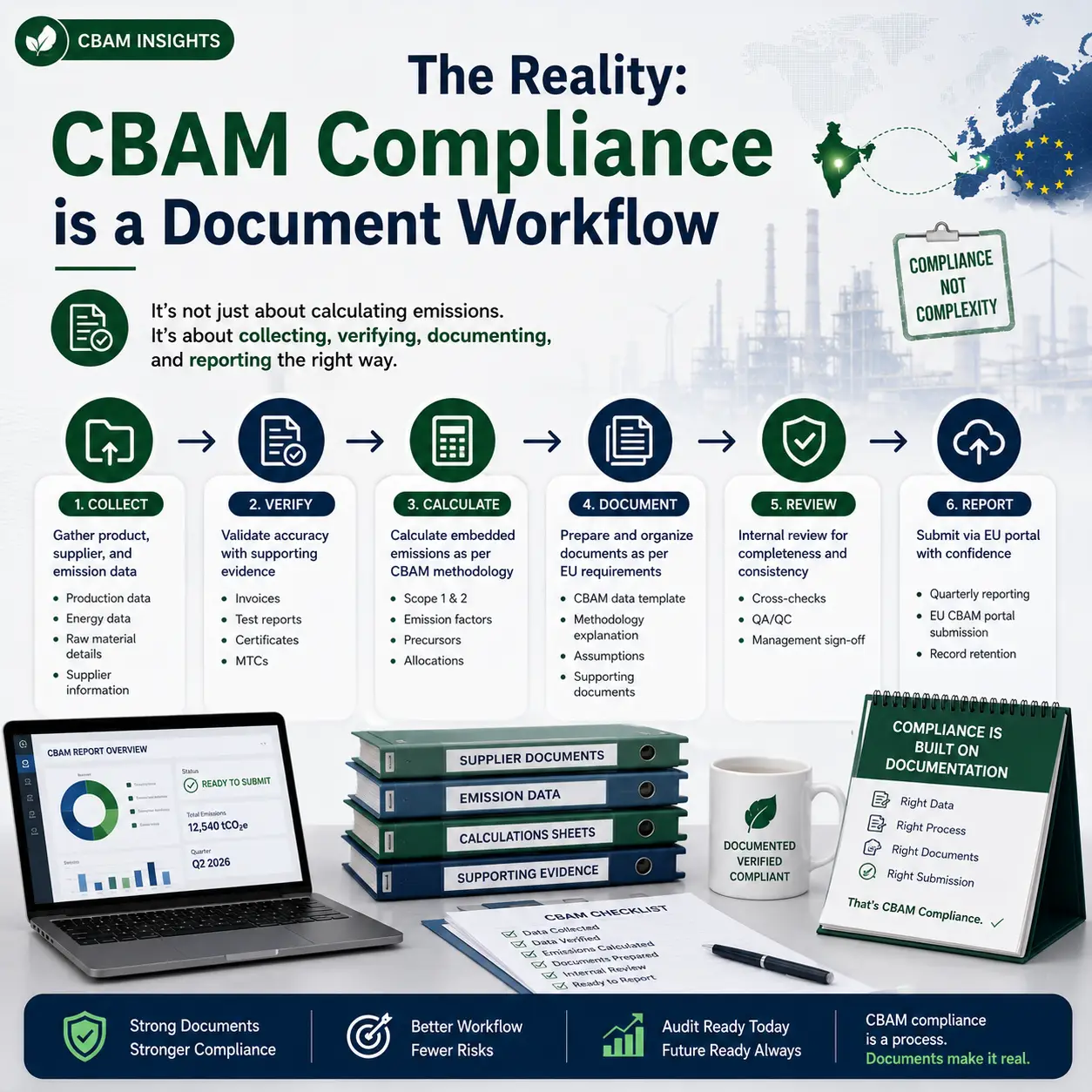
The reality on the shop floor is far simpler. Complying with CBAM is primarily an operational document management and allocation exercise.
Over 90% of the raw data required to calculate your product’s embedded emissions already exists inside your factory. It is stored in your monthly utility invoices, diesel logbooks, raw material test certificates, and daily production weighment records. You do not need to invent new data—you simply need to route existing operational records into an audit-ready format.
Moving from Yearly Panic to Monthly SOPs
Under the 2026 Definitive Phase rules, self-declared estimates and end-of-year guesswork are no longer accepted. EU importers must submit third-party verified emissions declarations tied directly to actual production runs.
If your plant tries to assemble 12 months of missing energy records right before an annual audit deadline, critical receipts will be lost, sub-meter readings will be forgotten, and your importer will be forced to apply punitive EU Default Values—artificially driving up the tax on your exports.
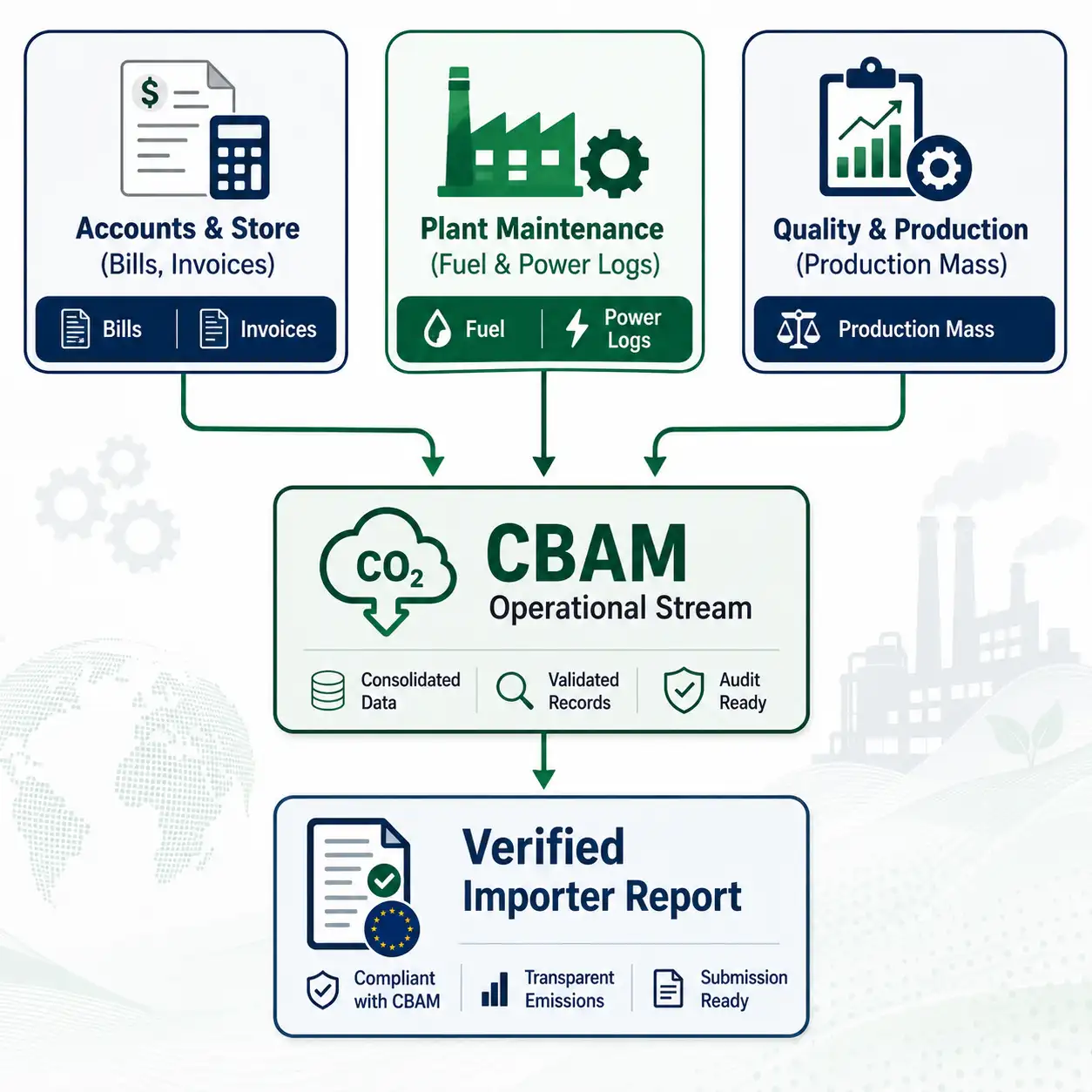
By establishing a simple monthly Standard Operating Procedure (SOP) on your factory floor, you can capture this data in less than 30 minutes a month without disrupting daily manufacturing operations.
Mapping Departmental Ownership — Who Holds What Data?
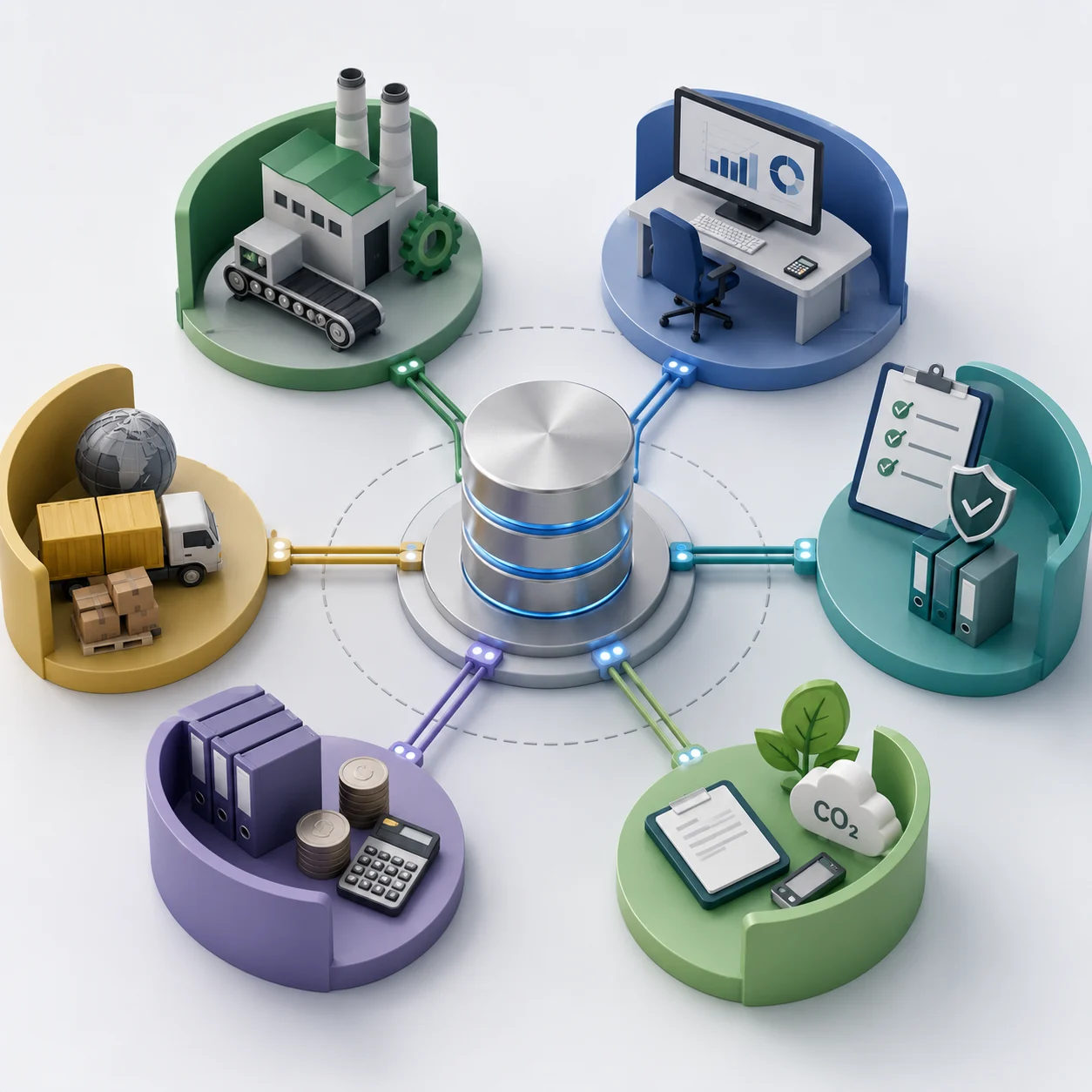
The biggest bottleneck in MSME data collection is lack of clarity around responsibility. When no single team owns the data, the task defaults to an overworked plant manager.
To build a seamless data pipeline, break down the reporting requirements across four existing departments inside your facility:
1. Accounts & Finance Department
Your finance and accounts team holds the verified financial evidence required to back up energy consumption numbers during an audit.

- State Electricity Board (DISCOM) Bills: Monthly invoices showing total active power consumption in kilowatt-hours (kWh), power factor adjustments, and maximum demand indicators.
- Stationary Fuel Invoices: Financial purchase receipts for bulk fuels delivered to the facility, including Furnace Oil (FO), Light Diesel Oil (LDO), High-Speed Diesel (HSD), Natural Gas (PNG/LNG), Liquefied Petroleum Gas (LPG), and Coal/Petcoke.
- Captive Renewable Documents: Power Purchase Agreements (PPAs), wheeling charges, and generation credit statements if your plant utilizes off-site or open-access solar/wind power.
2. Maintenance & Utility Operations
While Accounts holds the financial bills, your maintenance team tracks where and when that energy was physically consumed on the shop floor.

- Diesel Generator (DG) Logbooks: Daily running hours, kilowatt-hours generated, and liters of diesel filled into backup generators allocated specifically during export production runs.
- Sub-Meter Records: Shift-wise or monthly kWh readings for dedicated production equipment (e.g., induction furnaces, rolling mills, heat-treatment lines, or wire-drawing machines).
- Boiler & Reheating Furnace Logs: Direct fuel consumption records tied to specific operational shifts or campaign runs.
3. Stores & Procurement Department
Because raw material precursors (such as steel billets, wire rods, or aluminum ingots) carry embedded carbon from upstream suppliers, your procurement team holds the key to your product’s total footprint.

- Raw Material Invoices: Total mass in metric tonnes (t) of input materials purchased for manufacturing.
- Mill Test Certificates (MTCs) & Supplier Statements: Manufacturer test certificates that detail the heat number, chemical composition, and specific embedded carbon intensity (tCO2e/t) provided by your raw material vendors.
- Country of Origin Documentation: Certificates confirming where the raw precursor material was originally melted or produced.
4. Production & Quality Control (QC)
The production team provides the denominator for all CBAM calculations: the exact volume of finished, saleable goods produced from those energy inputs.

- Production Output Records: Total gross and net mass (t) of finished products manufactured per production line or batch.
- Scrap & Yield Loss Registers: Tonnage of internal scrap generated, recycled back into the furnace, or sold off, ensuring accurate mass-balance calculations.
- CN/HS Code Matching Logs: Quality records confirming that specific batch outputs correspond to the correct 8-digit EU Combined Nomenclature (CN) export code.
| Department | Key Document / Source | CBAM Data Point |
| Accounts | DISCOM Monthly Electricity Invoices | Grid Power Consumed (kWh) |
| Maintenance | DG Set Fuel Register & Sub-Meters | Diesel Used (L) & Line Electricity (kWh) |
| Procurement | Mill Test Certificates (MTCs) & Invoices | Precursor Mass (t) & Vendor Carbon Intensity |
| Production | Daily Production & Weighment Logs | Net Finished Mass (t) & Scrap Yield (t) |
Step-By-Step SOP — Setting Up Your Shop-Floor Data Pipeline

Once departmental roles are defined, the next challenge is execution. Without a repeatable routine, data collection devolves into an annual rush filled with missing invoices and estimated figures.
To prevent data gaps that trigger EU audit rejections, implement this 4-step Standard Operating Procedure (SOP) within your manufacturing workflow.
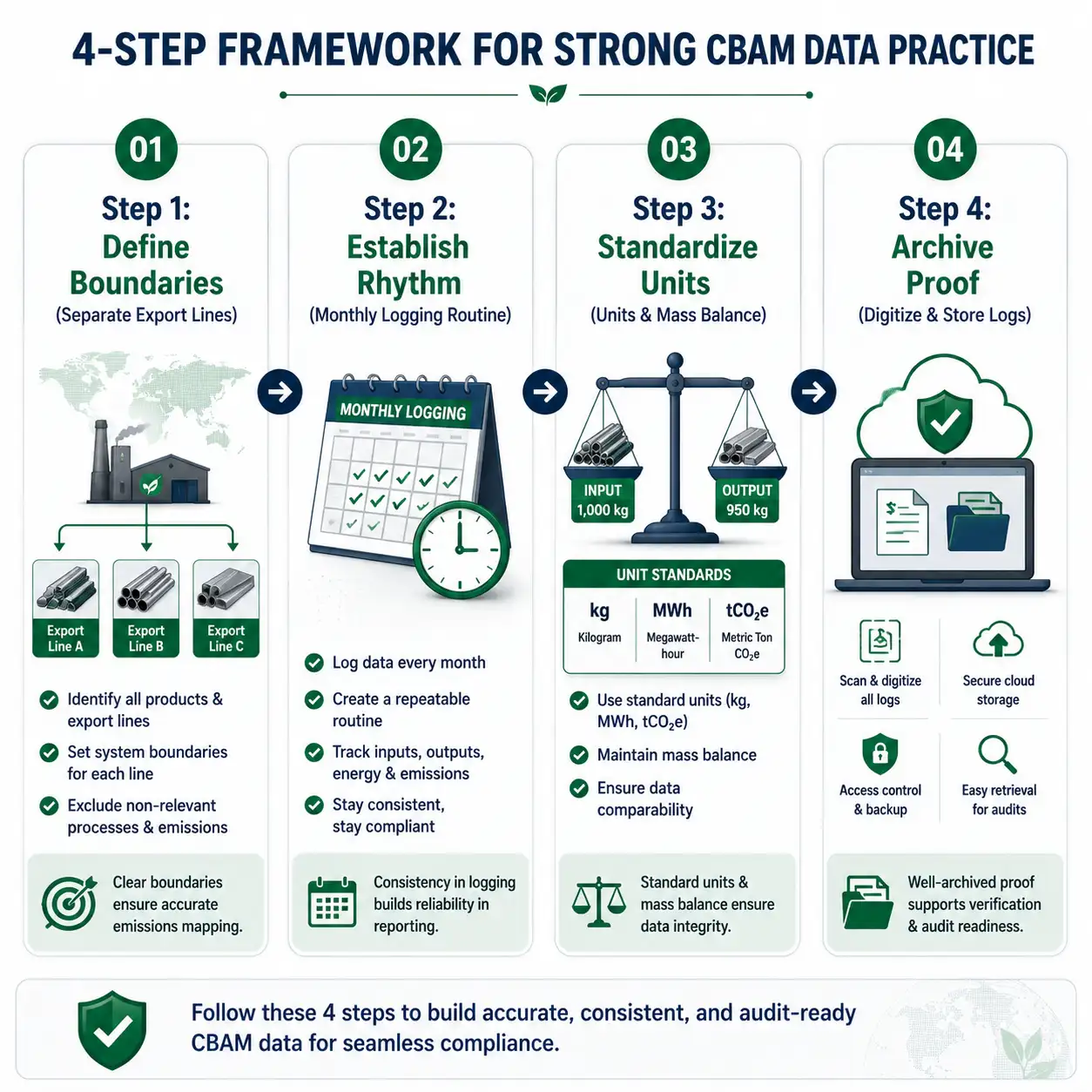
Step 1: Define System Boundaries (Isolate Export Production)
Not every kilowatt-hour consumed in your facility goes into an EU-bound product. If your plant manufactures non-CBAM domestic goods alongside EU exports, you must establish clear system boundaries:
- Direct Allocation: Install sub-meters on production lines dedicated to export orders (e.g., your primary rolling mill or heat-treatment furnace).
- Proportional Allocation: If the same machine produces both EU exports and domestic goods, allocate energy based on mass balance:
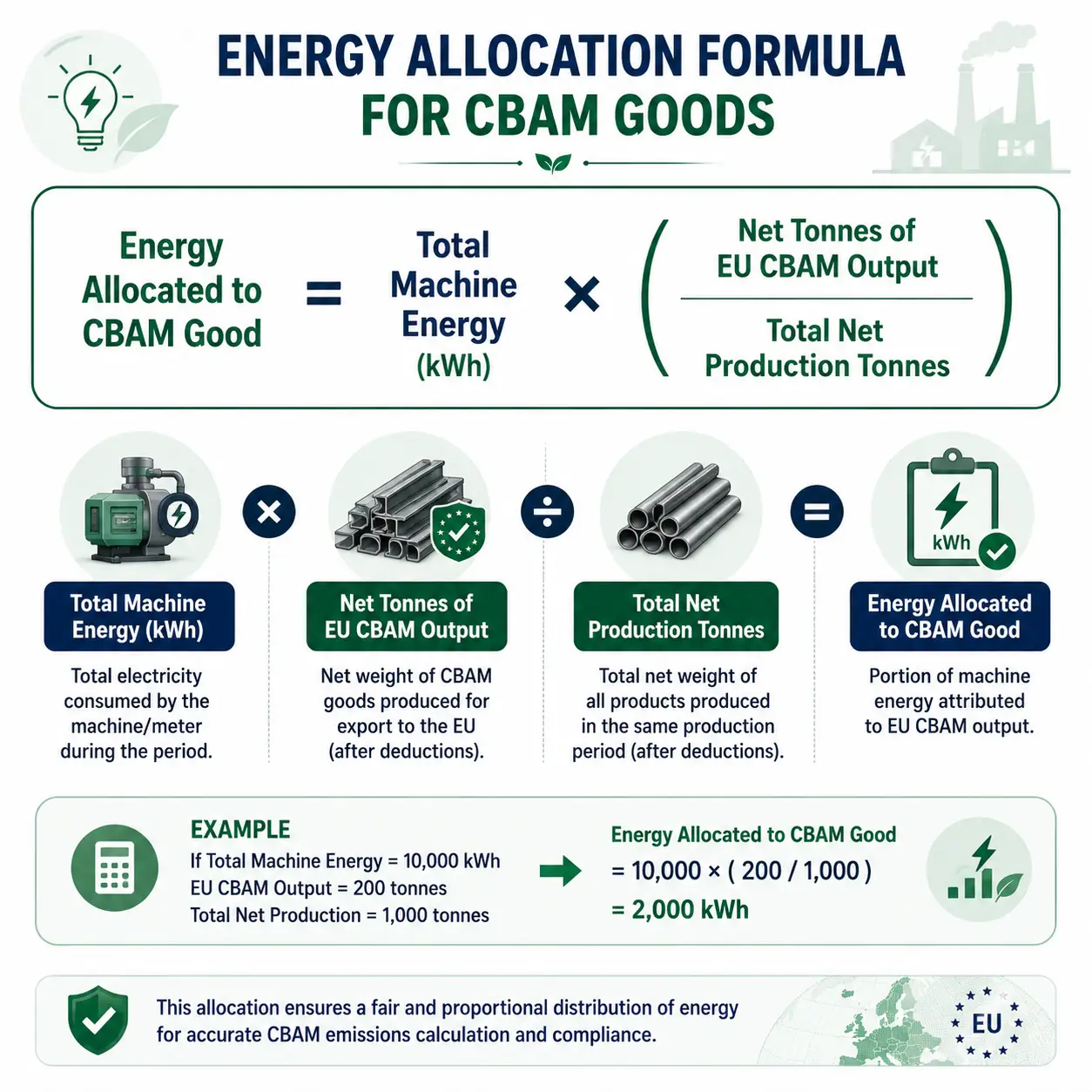
Step 2: Establish a Monthly Logging Rhythm
Waiting until the end of the year to collect energy data guarantees missing receipts and inaccurate allocations.
- Require Maintenance and Accounts to record energy data on the 1st working day of every month.
- Review energy-per-tonne ratios monthly. A sudden spike in electricity per tonne of output signals either a sub-meter tracking error or equipment inefficiency on the shop floor.
Step 3: Standardize Units & Mass Balances
Conversion errors are a leading cause of rejected CBAM declarations. Maintain fuel logs in raw physical units rather than financial costs:
- Electricity: Kilowatt-hours (kWh) or Megawatt-hours (MWh).
- Liquid Fuels (Diesel, FO, LDO): Liters (L) or Metric Tonnes (t). Record specific gravity if available.
- Gaseous Fuels (PNG, LPG): Standard cubic meters (Nm3) or Kilograms (kg).
- Finished Goods & Scrap: Net Metric Tonnes (t) weighed using calibrated weighbridges.
Step 4: Centralize & Digitize Raw Evidence
Under EU rules, raw figures are invalid without physical proof. Create a centralized cloud or local repository named CBAM_Audit_[Year] and upload digital copies of:
- Utility bills stamped “Paid.”
- Dated photos of physical meter dials.
- Signed DG fuel logs.
- Calibrated weighbridge slips for finished output.

Precursor Tracking — Managing Supplier Carbon Passports

For manufacturers of complex goods (such as steel fasteners, forged flanges, or aluminum profiles), raw material precursors make up 50% to 85% of your final product’s embedded footprint.
If you purchase steel billets or wire rods from an external mill, you cannot calculate your CBAM score using factory energy logs alone—you need carbon data from your suppliers.
The Mandatory Data Chain
In the 2026 Definitive Phase, you must collect supplier data systematically:
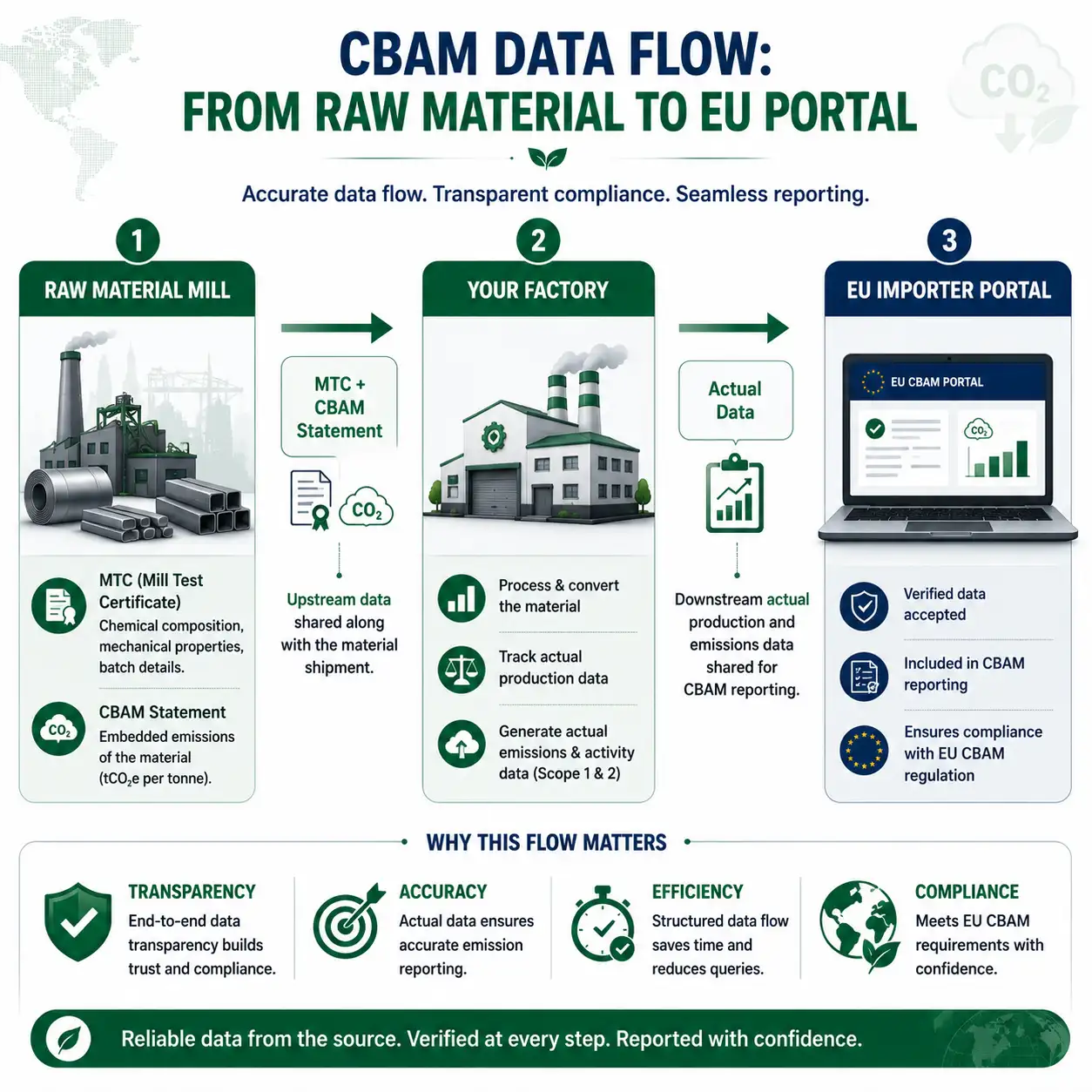
- The Rule: You must obtain actual emissions data for your primary precursor materials directly from your suppliers.
- The Penalty for Missing Supplier Data: If a vendor refuses or fails to provide actual emissions figures, your importer will be forced to apply EU Default Values for that raw material. In the definitive phase, default values are set at punitive, high-emission levels, raising the carbon tax on your final product.
Standard Supplier SOP for Purchase Teams
Your procurement team should update standard purchase terms with all raw material suppliers:
- Mandate CBAM Supplier Statements: Include a standard clause in Purchase Orders (POs) requiring vendors to attach an accredited CBAM Declaration / Emission Certificate alongside standard Mill Test Certificates (MTCs).
- Verify Required Data Fields: Ensure your supplier’s statement includes:
- Production installation country of origin.
- Specific embedded direct emissions (tCO2e /t of precursor).
- Specific embedded indirect emissions (tCO2e /t), where applicable.
- Specific production route (e.g., Blast Furnace vs. Electric Arc Furnace).
- Understanding Supplier Default Penalties (The 80/20 Rule)
Under 2026 definitive rules, at least 80% of your product’s total embedded footprint must come from verified actual data. If a raw material vendor fails to provide verified data, you can temporarily cover up to 20% using EU default values.
However, relying on default values comes at a high price. The EU imposes an escalating financial penalty on default data:
- 2026 Penalty: +10% markup above the sector-country average.
- 2027 Penalty: +20% markup.
- 2028 Onward: +30% markup.
- Providing actual verified numbers for your raw inputs is the only way to avoid this direct tax on your export margins.
Procurement Action Item: Download our standardized “Supplier CBAM Data Request Template” to hand to your raw material vendor network, ensuring they supply the exact data format required by your EU buyers.
💡 Procurement Action Item
Download our standardized “Supplier CBAM Data Request Template” to hand to your raw material vendor network, ensuring they supply the exact data format required by your EU buyers.
Preparing for the Mandatory Verification Audit

In the Definitive Phase, data collection is only half the battle. The EU no longer accepts simple self-declarations; your factory-floor numbers must withstand an independent audit before your EU importer can submit their annual CBAM declaration.
An accredited third-party verifier will cross-examine your claimed emissions against raw shop-floor evidence. If your data trail has gaps, your report will be rejected, forcing your buyer to apply punitive EU Default Values with markups starting at 10% and escalating over time.
Gathering factory data is only step one. Formatting these numbers into official, accredited CBAM XML declarations requires specific emission factors and calculations. [Upload your data checklist to our automated CBAM portal] or [speak with our compliance team] to generate your audit-ready CBAM report today.
The 4-Year Document Retention Mandate
Under EU CBAM regulations, both EU importers and overseas manufacturing facilities are legally required to store all underlying data, calculation sheets, and raw evidence for a minimum of four years following the end of the reporting year.
If EU customs or an accredited verifier requests a retroactive audit of your 2026 export data anytime through 2030, you must be able to produce the exact supporting documentation within days.
The Audit-Proofing Evidence Checklist
To ensure your shop floor passes a third-party verification audit without friction, maintain an archived digital “Audit Pack” containing:
- Primary Fuel & Energy Evidence: Stamped monthly DISCOM electricity bills, utility payment receipts, and meter-reading logbooks.
- Physical Fuel Records: Signed fuel delivery slips, weighbridge receipts for coal or biomass, and daily DG set run-hour registers.
- Production Tonnage Proof: Calibrated weighbridge slips, shift-wise output logs, and financial sales invoices matching physical output mass.
- Precursor Documentation: Verified Mill Test Certificates (MTCs), supplier CBAM emission statements, and purchase invoices for all raw input materials.
- Calibration & Maintenance Logs: Calibration certificates for energy sub-meters, weighbridges, and flow meters to prove data accuracy to the auditor.

Conclusion — Turn Shop-Floor Data into Export Advantage

Collecting CBAM-ready data does not require hiring expensive external consultants or halting your manufacturing lines. As this playbook demonstrates, over 90% of the numbers you need already exist across your Accounts, Maintenance, Procurement, and Production logs.
By establishing a clear monthly Standard Operating Procedure (SOP), mapping departmental ownership, and archiving raw evidence, your plant can turn a complex EU climate regulation into a routine 30-minute monthly operational task.
Accurate, verified data is no longer just a legal requirement—it is your strongest competitive advantage in the European market. Indian MSMEs that deliver verified, actual low-emission data enable their EU buyers to avoid costly default markups, securing long-term supplier contracts while competitors struggle with compliance.
Ready to Automate Your Shop-Floor CBAM Workflow?
Stop spending hours copying numbers across disconnected spreadsheets and risking data-entry errors.
- [Download the Free Factory Floor CBAM Data Collection Log (PDF)]: Hand this ready-to-use template directly to your plant manager to start tracking monthly inputs seamlessly.
- [Upload Your Monthly Plant Data for Automated Report Generation]: Let our specialized platform convert your raw DISCOM bills, fuel logs, and MTCs into verified, audit-ready CBAM XML files.
- [Book a 15-Minute Data Audit with Our Compliance Specialists]: Have our team review your current plant logging SOPs to ensure you meet all EU verification standards.
In 60 minutes, we will review your export profile, assess your CBAM exposure, and recommend the right compliance strategy.
What Comes Next?
Teaser for Article 5: Actual vs. Default Values—The Hidden Financial Penalty Destroying Export Margins
Now that your plant has a shop-floor SOP to collect raw energy and production logs, a critical strategic question remains: Should you submit your plant’s verified actual emissions data, or rely on the EU’s published Default Values?
Many MSME owners assume that taking the shortcut of using standard default values saves time and administrative hassle. In the 2026 Definitive Phase, that shortcut is a massive financial trap.
In our next guide, we pull back the curtain on how default values work under 2026 rules:
- The Escalating Penalty Matrix: Why the EU explicitly marks up default values (+10% in 2026, rising to +30% by 2028), making unverified goods significantly more expensive for European importers.
- The Buyer Decision Framework: How EU importers compare supplier carbon scores, and why high default values will cause buyers to drop unverified Indian suppliers for lower-carbon global competitors.
- The ROI of Actual Data: A line-by-line financial comparison proving how calculating actual emissions directly protects your price competitiveness and export profit margins.
Coming Up Next: Actual vs. Default Values: Why Relying on EU Carbon Benchmarks Is Costing Indian MSMEs Millions.